Loading... Please wait...
 EUR



Blog
Recent Posts
Diamond color F: How It Looks in Different Settings
Posted on
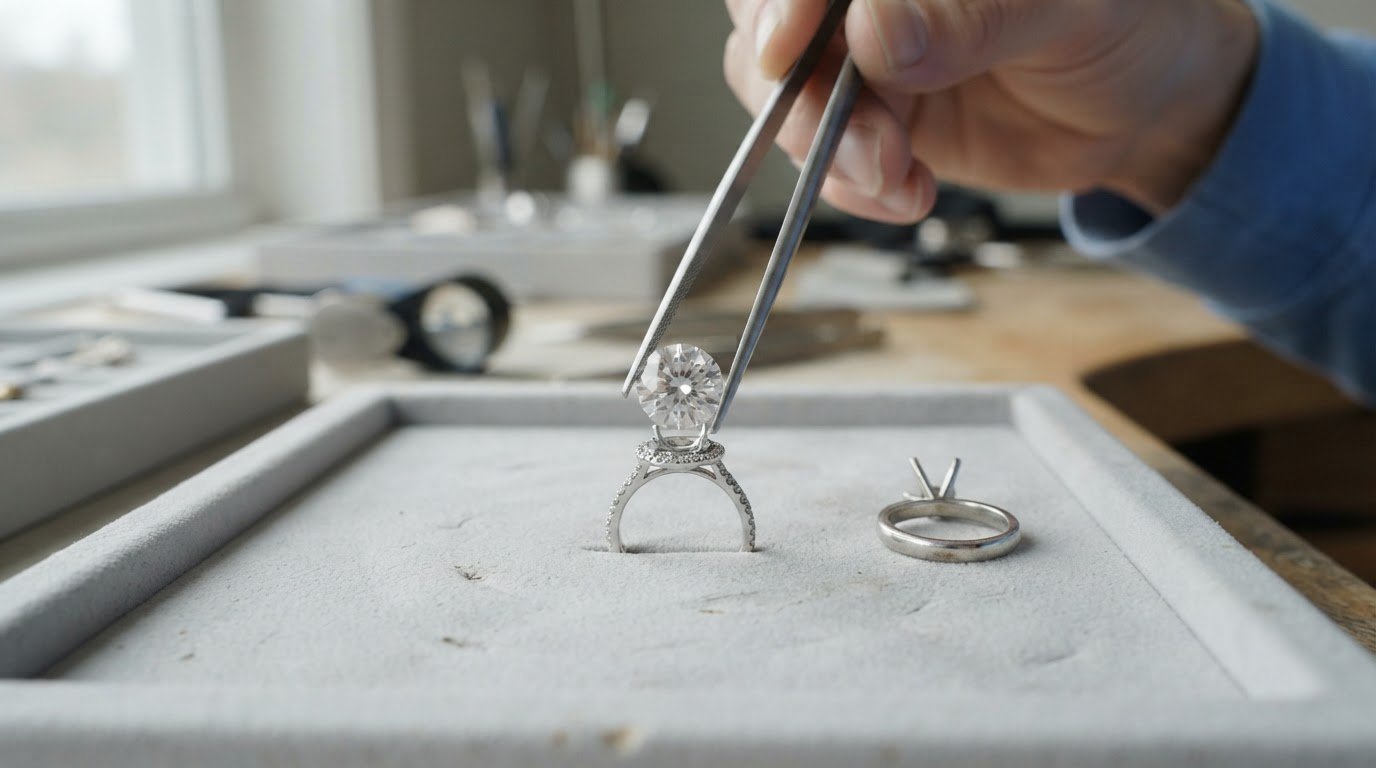
An F grade is the third and final grade in the colorless range of the D-to-Z scale, after D and E. For diamond color, F is just below the highest grades, but the difference is difficult to see with the naked eye. The grade describes a diamond’s body color, not its entire appearance when worn.
A high color grade can be appealing if you want a bright, white-looking diamond, but size, shape, lighting, and setting also affect how its color appears. This guide compares F with nearby grades and explains why larger diamonds and step cuts may show color differently, so you can assess the grade in context.
Key Takeaways
- F sits at the lower end of the colorless range, but the difference from the top grades is hard to see without magnification.
- Compare a diamond with its side stones and setting in mind, since surrounding stones and metal can affect how its color appears.
- Consider size and shape together: larger diamonds and step cuts can make body color easier to notice.
- Look at the exact stone in different viewing conditions to judge whether its appearance suits your preferences.
What are the different diamond color grades?
The GIA D-to-Z scale grades a diamond’s body color, from D at the colorless end to Z. F is near the top of the scale, but appearance, clarity, and personal priorities all matter when choosing a stone.
F on the GIA Color Scale
On the GIA scale, the diamond color F grade is the third and final grade in the colorless range, after D and E. GIA introduced its D-to-Z Color Scale in 1953. Gemologists compare stones with masterstones under controlled lighting, providing a consistent framework for assessing color. F is one grade below the top two, which can help buyers weigh color against other priorities.
Colorless Classification and Appearance
F is classified as colorless, while G begins the near-colorless range. The subtle differences among D, E, and F are difficult to see without a direct comparison. White gold can complement a bright appearance, but the metal does not determine a diamond’s grade. Clarity describes inclusions and blemishes, not body color, so consider these characteristics separately.
To verify an F grade, read the grading report and confirm that it identifies the diamond’s color as F. Match the report’s identifying details to the exact stone. Certification practices vary, so check the grading report and laboratory details.
Comparing F With Lower Color Grades
When comparing F with lower grades, remember that G is one step below, followed by H and other near-colorless grades. Most people find it difficult to spot a one-grade difference once diamonds are mounted and viewed in everyday settings. F diamonds are generally less expensive than D- and E-color diamonds, though cut and clarity also affect price.
Color grade alone does not determine resale value or make a diamond an investment or collection-grade purchase. Consider the stone’s documented characteristics and market demand, then choose based on the appearance and features you value.
F color diamonds in side-stone, halo, and pavé settings
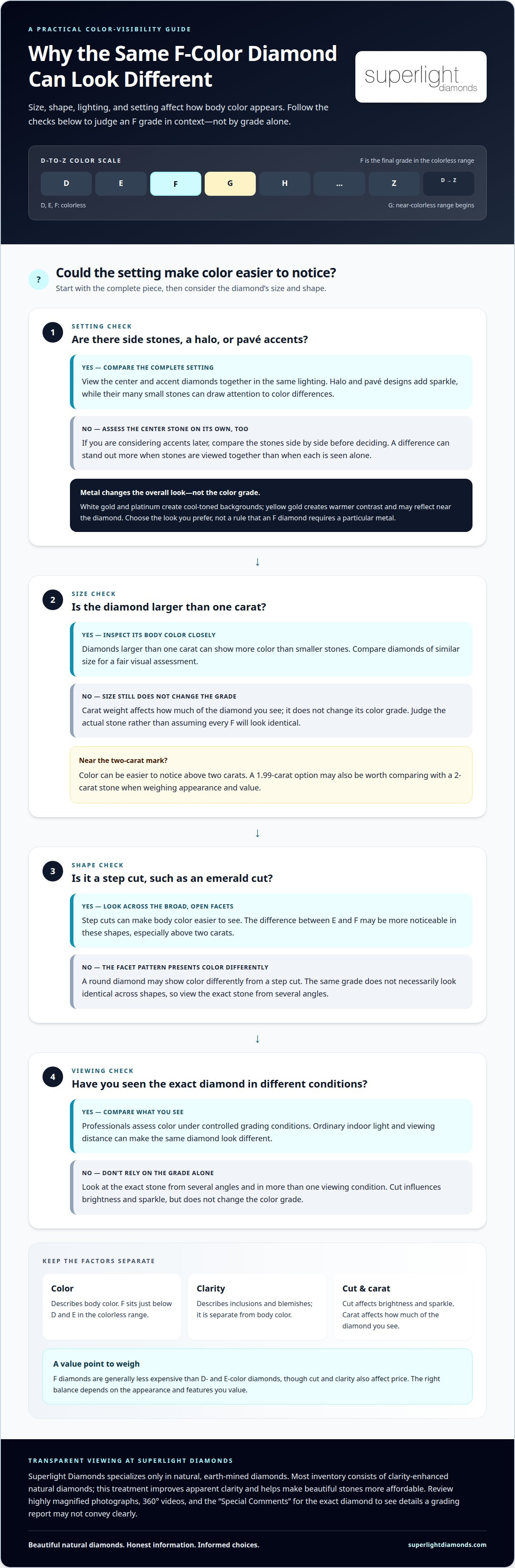
In a side-stone engagement ring, the center diamond sits beside smaller accent stones. Choose accents with a compatible color grade and view the complete piece together. Color contrast can stand out more than either stone’s grade viewed alone. Comparing them in the same lighting helps you judge whether the difference is visible to the naked eye.
A halo places small diamonds around the center stone, while pavé settings use closely set stones along the band. Both designs add sparkle, but their many accents can draw attention to color differences. View the finished combination, not just the center-stone description. Controlled lighting helps with comparison, while ordinary indoor light gives a sense of how the setting may look day to day.
White gold and platinum provide cool-toned backgrounds that complement a bright, white appearance. Yellow gold creates a warmer contrast around an F center stone, and its color may reflect near the diamond. Neither metal changes the diamond’s color grade. Choose based on the overall look you prefer, not on a rule that an F diamond requires a premium metal.
For a vintage setting, consider how details such as milgrain edges and engraved metal frame the center. Before buying, compare the center and accents side by side, and view the ring from above and at an angle. If you’re weighing different stones, compare natural diamond options in the setting style you prefer, rather than choosing by grade alone.
Diamond size, shape, and visible color
Carat weight affects how much of a diamond you see, not its color grade. Diamonds larger than one carat can show more color than smaller stones, and color becomes easier to notice in diamonds above two carats. An F diamond may therefore look different depending on its size, even though its grade stays the same. Compare stones of similar size for a fair visual assessment.
Shape matters, too. Step cuts, such as emerald cuts, have broad, open facets that can make body color easier to see. The difference between E and F may be more noticeable in these shapes, especially above two carats. A round diamond’s facet pattern presents color differently, so the same grade may not look identical across shapes. View the exact stone from several angles.
Cut quality influences how light moves through a diamond, contributing to its brightness and sparkle. It does not change the color grade, but a lively appearance can draw attention to light return rather than subtle body color. Professionals assess color under controlled grading conditions, while everyday lighting and viewing distance can make the same diamond look different.
Clarity also describes a separate feature: internal inclusions or surface blemishes. It doesn’t raise or lower color, though visible inclusions can affect how clean the diamond looks to the naked eye. Compare cut, carat, and clarity as distinct factors, then decide which combination suits your priorities. For example, a buyer may favor a larger stone over a higher color grade. A 1.99-carat option may also be worth comparing with a 2-carat stone when weighing value.
To compare shape and size directly, explore natural diamond options and focus on each stone’s actual appearance, not its grade alone.
Superlight Diamonds: Round Brilliant Diamonds
Superlight Diamonds specializes only in natural earth-mined diamonds, including Round Brilliant, Princess Cut, and Cushion Cut Diamonds. Most of its inventory consists of clarity-enhanced natural diamonds. This treatment improves a diamond’s apparent clarity and helps make beautiful stones more affordable.
To compare an F-color diamond with other options, review the exact stone’s highly magnified photographs, 360° video, and “Special Comments.” These details can show characteristics that a grading report may not convey clearly, helping you assess the diamond’s appearance and make an informed choice.
Explore Superlight Diamonds’ natural diamond selection or contact Superlight Diamonds with your questions.
Choose the Diamond That Feels Right for You
Let your priorities guide your final choice. If an F grade appeals to you, consider how the individual stone looks in the jewelry you plan to wear. Shape, size, and setting all contribute to its overall appearance, so focus on the combination that suits your taste and budget.
Superlight Diamonds offers Round Brilliant and Princess Cut Diamonds, as well as clarity-enhanced diamonds. Compare the exact stones using their photographs, 360° videos, and listing comments. This gives you a closer look at each diamond’s characteristics as you weigh your preferences.
Ready to discuss your options? Contact Superlight Diamonds for help as you consider your next step. Choose the diamond that feels right for you.
Frequently Asked Questions
Is color more apparent in certain shapes and sizes?
Yes, and the viewing setup can affect what you notice. For a useful comparison, place the stones on a plain white background and view them from the same distance. Avoid comparing one under a bright spotlight and another in softer room light. This makes it easier to assess each diamond without the setting or lighting distracting from the stone.
What does F color mean on the diamond color grading scale?
F is a specific color designation, not a summary of a diamond’s overall quality. A report also records characteristics such as clarity and cut, which describe different aspects of the stone. When comparing two F diamonds, use those details to understand why their appearances may differ, rather than expecting the shared color grade to tell the whole story.
Is an F color diamond considered colorless?
Yes. The classification describes a diamond’s place in the grading system, but does not guarantee an identical appearance in every piece of jewelry. If you have already chosen a setting, consider how the finished design will look alongside your usual jewelry. A loose diamond can look different from one set among accent stones or colored metal.
How does F color compare with D, E, G, and H diamonds?
F falls below D and E, and above G and H. The useful buying question is how much the visual difference matters to you compared with other priorities. Compare the actual stones in your preferred shape, then decide whether a subtle color distinction matters more to you than size or clarity within your budget.
Can you see the difference between F color and G or H diamonds with the naked eye?
The difference can be difficult to identify without a direct comparison. If you are unsure which appearance you prefer, look at each diamond separately after comparing them side by side. This helps keep the contrast from becoming your only reference. Consider which stone appeals to you on its own, since that is how you will usually see it when worn.