Loading... Please wait...
 EUR



Blog
Recent Posts
How Visible Are Carbon Spots in Different Diamonds?
Posted on
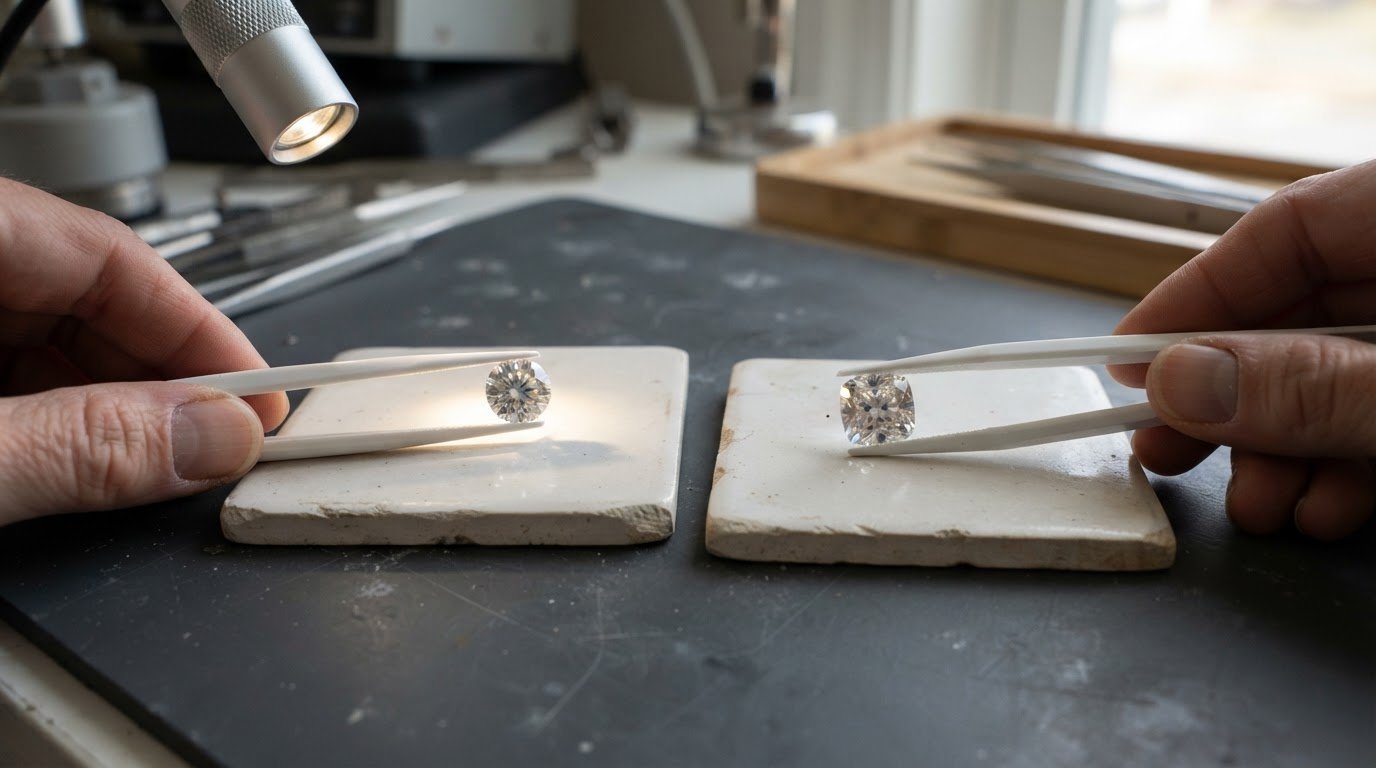
A black carbon spot can be nearly impossible to see or stand out immediately, even in a beautiful diamond. Its visibility depends on its size, position, contrast, and the diamond’s color. Some spots show only under magnification, while others are visible to the naked eye.
It’s natural to wonder whether a dark inclusion affects a diamond’s appearance or clarity grade. The answer varies: a spot that contrasts strongly with a white diamond may blend in differently with a fancy-color or black diamond. This article explains what carbon spots are, how they affect clarity and appearance, and what to look for when comparing diamonds.
Key Takeaways
- Judge a dark inclusion by its size, position, and contrast, not just by its presence.
- Learn how clarity grades account for inclusions and when a spot may be visible without magnification.
- Consider how a diamond’s body color can change the contrast and appearance of a dark spot.
- Use close-up images and video alongside grading details to assess the exact diamond’s appearance.
How do Black Spots Affect Clarity Grades?
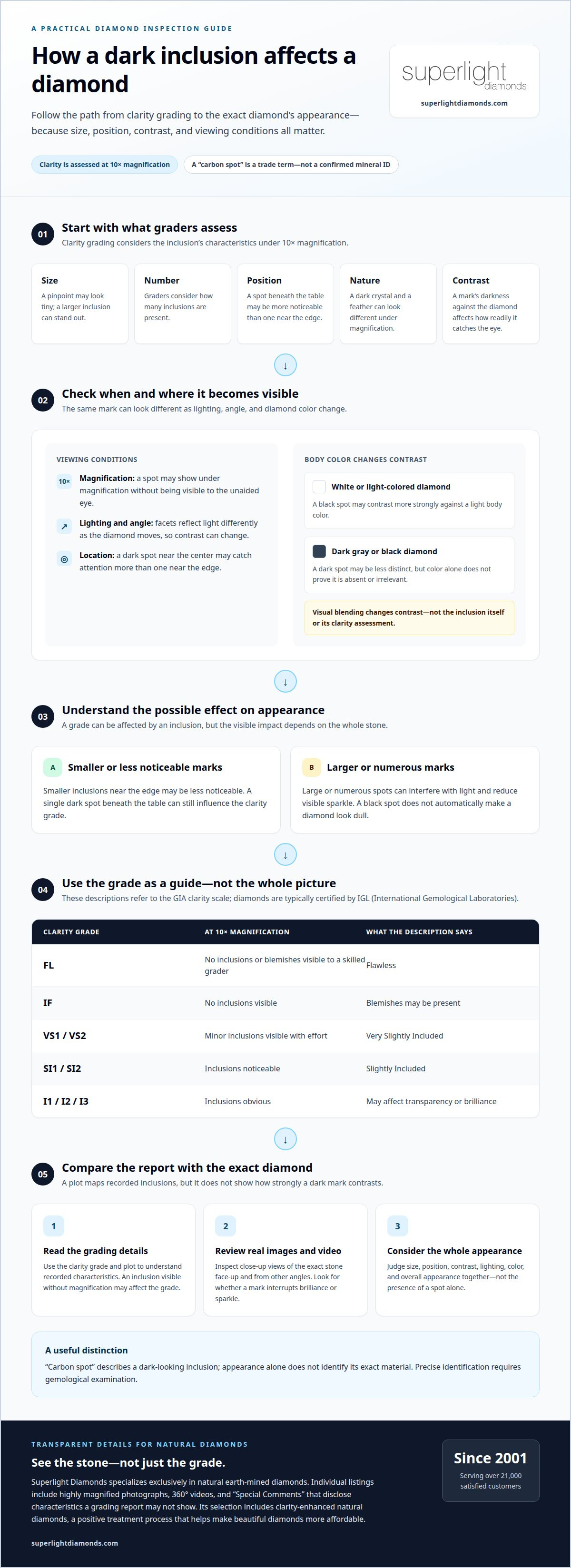
Clarity grading considers an inclusion’s size, number, position, nature, and contrast. Graders assess inclusions and surface blemishes under 10x magnification.
Visibility by Size, Location, and Lighting
A black spot’s visibility depends on its size, position, contrast, and viewing conditions. Under 10x magnification, a pinpoint may look like a tiny speck, while a larger inclusion can stand out. A dark spot beneath the table, the large central facet area, may be more noticeable than one near the edge. Lighting and viewing angle can also change its contrast, making a spot appear stronger in some conditions.
Effects on Sparkle and Value
An inclusion can lower a diamond’s clarity grade and affect its value, but the impact depends on the stone’s overall appearance. A single dark spot beneath the table may determine the grade, while smaller inclusions near the edge may be less noticeable. Large or numerous spots can interfere with light and reduce visible sparkle. A black spot doesn’t automatically make a diamond look dull; size and position matter.
Using Grades and Plots When Buying
Clarity grades help compare diamonds, while a plot maps recorded inclusions. Diamonds are typically certified by IGL (International Gemological Laboratories). On the GIA scale, VS1 and VS2 inclusions are minor and visible with effort under 10x magnification; SI1 and SI2 inclusions are noticeable at that magnification. I1, I2, and I3 inclusions are obvious under 10x and may affect transparency or brilliance. An inclusion visible to the unaided eye may affect a diamond’s clarity grade, though its impact depends on other factors. Compare the plot with the diamond’s actual appearance, since the diagram doesn’t show how strongly a dark mark contrasts. FL means no inclusions or blemishes are visible to a skilled grader; IF means no inclusions are visible, though blemishes may be.
What are diamond carbon spots?
“Carbon spot” is a trade term for a dark-looking inclusion, not a confirmed mineral identification. Its appearance alone doesn’t reveal its exact composition.
Carbon Spots and Other Black Inclusions
Black inclusions are crystals or other material trapped inside a diamond during its formation. GIA has reported that inclusions called carbon spots may include graphite, chromite, or sulfides. A dark crystal can appear as a distinct black spot, while a feather is a fracture-like feature that may look different under magnification. These differences matter because appearance alone cannot identify the material. Even a noticeable inclusion seen with the naked eye needs gemological examination for precise identification.
Cut, Shape, and Spot Visibility
Cut and shape affect how easily an inclusion catches the eye. Brilliant cuts, including round shapes, may disguise inclusions through their many facets and shifting reflections. Step cuts, such as emerald shapes, have broad, open facets that can make inclusions easier to notice. Black spots can occur in any cut or shape, so shape alone doesn’t determine visibility. A setting’s prong may partly cover a spot near the edge, but it doesn’t change the inclusion or its grading.
Treatments may reduce the appearance of some dark inclusions. Laser drilling can create a narrow channel or cavity where dark material was removed; fracture filling can improve the appearance of certain internal fractures. These processes alter visibility, not how the diamond originally formed. Treatment details should be disclosed at purchase. When considering a natural diamond, compare close-up images and grading information for the exact stone before choosing jewelry.
Carbon spots in fancy-color and black diamonds
Black spots generally contrast more strongly against white or light-colored diamonds than against diamonds with a dark body color. In fancy-color diamonds, visibility depends on the color and tone around each inclusion, so a dark spot may blend in or stand out.
Color changes contrast, not the inclusion itself. A black pinpoint may be noticeable against a yellow diamond’s bright body color, while a similar mark may be less distinct in a dark gray or black diamond. Visual blending doesn’t establish the spot’s size, nature, or effect on clarity. A gemological assessment considers the individual stone rather than assuming its color conceals every imperfection.
Lighting can also affect what you see. Facets reflect and return light differently as a diamond moves, potentially revealing a spot that seemed hidden from another angle. A fracture and a dark crystal can look different under magnification, even when both create a mark inside the stone. Compare the diamond face-up and from other angles, noting whether pinpoints or larger features interrupt its brilliance or sparkle.
Black diamonds deserve the same close visual assessment as fancy-color stones. A dark body color may reduce contrast with a black inclusion, but it doesn’t prove the mark is absent or irrelevant. The setting frames the diamond but doesn’t change its internal features. Review clear views of the exact diamond under consistent lighting, then consider its color, visible inclusions, and overall appearance together. This helps you assess a particular spot’s visibility rather than relying on color alone.
Superlight Diamonds
Superlight Diamonds specializes exclusively in natural earth-mined diamonds, with one of the largest online selections of loose diamonds and competitive pricing. Its selection includes clarity-enhanced diamonds, a positive treatment process that helps make beautiful natural diamonds more affordable. Since its founding in 2001, Superlight Diamonds has served over 21,000 satisfied customers.
For a diamond with a dark inclusion, transparent details matter. Individual listings include highly magnified photographs, 360° videos, and “Special Comments” that disclose characteristics a grading report may not show. Review images and video of the exact stone to understand its appearance from different angles before deciding what suits your preferences and budget.
Contact Superlight Diamonds for guidance as you compare natural diamonds.
Choose a Diamond That Feels Right to You
Let your priorities guide your choice. A dark inclusion may matter less to you than the diamond’s overall look, or you may prefer a cleaner appearance when viewed without magnification. The visibility of black carbon spots in diamonds is one consideration among color, shape, sparkle, and budget. A clarity grade alone doesn’t make the decision.
When comparing options, focus on the exact stone and the details that affect how much you enjoy its appearance. Round Brilliant Diamonds, Princess Cut Diamonds, and Clarity Enhanced Diamonds offer different options for balancing appearance and value. Clear product information can help you make an informed comparison.
For guidance as you consider your preferences, contact Superlight Diamonds. Take the next step at your own pace and choose the natural diamond that suits you.
Frequently Asked Questions
Can They be Removed?
Routine cleaning won’t remove an inclusion trapped inside a diamond. Some treatments can reduce the appearance of certain dark features, but they alter the stone and don’t make the original inclusion disappear in every sense. A treated diamond’s description should identify the treatment clearly, so buyers understand what they’re viewing and how its appearance has changed.
Is a Carbon Spot Actually Carbon?
Not necessarily. “Carbon spot” is a common trade description, but a black inclusion may consist of other minerals, including chromite or sulfides. Diamonds themselves are largely carbon, which may explain the familiar term, but color alone can’t identify an inclusion’s composition. Exact mineral identification requires gemological analysis, not just a photograph or visual inspection.
What do They Look Like?
A black inclusion may appear as a tiny isolated speck, a group of dark pinpoints, a cloudy patch, or a narrow line. A faint shadow may seem to shift or disappear as the diamond’s angle changes, while a sharply defined inclusion remains distinct. Viewing the stone face-up and tilted can reveal different patterns, especially in magnified images.
What are black carbon spots in diamonds?
These are internal features that formed as a diamond developed, not dirt on its surface. The term describes their dark appearance, not a definite chemical identity. One stone might contain a small dark crystal; another might show several marks together. Their character and position help explain why similar-looking spots can appear quite different.
Can black carbon spots be seen without a loupe?
Yes. A spot can be visible without a loupe if its size and contrast make it stand out. Smaller inclusions may be difficult to notice during ordinary viewing, though magnification can reveal them. For a practical impression, view the diamond under more than one lighting condition and at normal viewing distance, not only in a highly enlarged image.