Loading... Please wait...
 USD
USD


Blog
Recent Posts
Diamond Clarity Scale Explained: How to Choose the Best Value in 2026
Posted on

Paying thousands of dollars for a "Flawless" rating is often the most expensive mistake a diamond buyer can make in 2026. You want a natural diamond that sparkles brilliantly and looks perfect on a ring, but the massive price jump between a VVS and a VS grade can feel like a financial trap. It's common to feel confused by grading reports, especially when you can't tell if a specific inclusion will actually be visible or if the stone will look cloudy. Having the diamond clarity scale explained will show you how to identify "eye-clean" stones that look identical to expensive gems to the naked eye while saving you 30% to 50% on your purchase.
We'll explore how to use high-definition 360° videos and detailed "Special Comments" to verify a stone's beauty beyond the certificate. You'll also learn how clarity-enhanced natural diamonds and IGL certification help you maximize your budget. By the end of this guide, you'll know exactly how to find a larger, more impressive stone that offers outstanding visual appeal without the unnecessary cost of microscopic perfection. This approach ensures you get the best possible value for your investment without compromising on the sparkle you deserve.
Key Takeaways
- Understand that the diamond clarity scale explained in this guide measures internal inclusions and surface blemishes that often require magnification to see.
- Learn how to identify "eye-clean" diamonds to save 30% to 50% by avoiding the high premiums of microscopic perfection.
- Discover how clarity enhancement transforms natural, earth-mined stones into beautiful, high-value options that fit your specific budget.
- Master the use of 360° videos and "Special Comments" to verify a stone's visual quality rather than relying solely on a grading report.
- Shift your focus toward larger, more impressive natural diamonds by choosing the right spot on the clarity scale for maximum sparkle.
Decoding the Diamond Clarity Scale: From Flawless to Included
Understanding how a professional grader evaluates a stone is the most effective way to protect your budget. When you have the diamond clarity scale explained, you realize that clarity isn't about how much a diamond sparkles. Instead, it measures the presence of internal characteristics called inclusions and surface traits known as blemishes. This technical assessment of Diamond Clarity is performed under 10x magnification. If a trait isn't visible at this power, it's considered non-existent for grading purposes. However, the shape of your diamond significantly impacts how these traits appear. A Round Brilliant cut has many facets that help hide inclusions, while step-cut shapes like Emerald or Asscher cuts act like windows, making even small marks more obvious.
The 11 Grades of the Clarity Scale
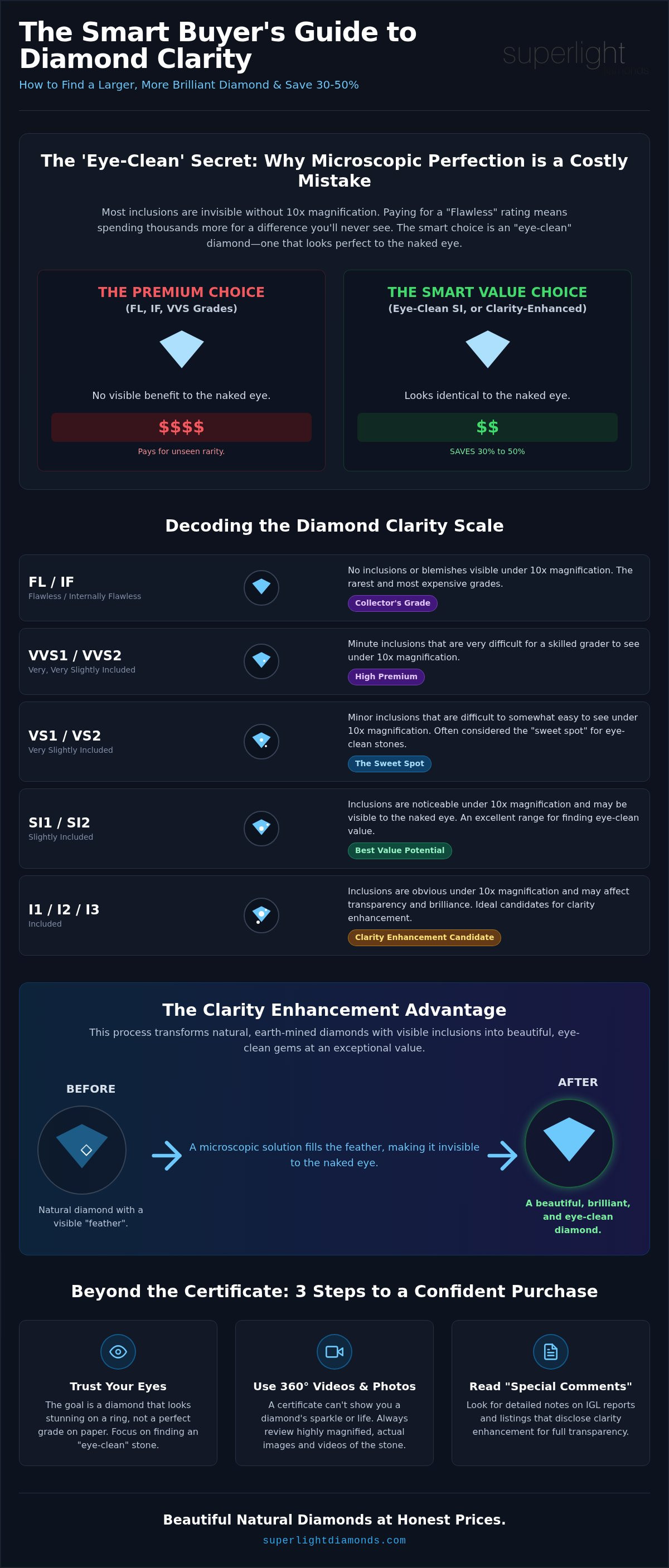
The standard scale ranges from Flawless to Included, categorized into 11 distinct grades. At the top, Flawless (FL) and Internally Flawless (IF) diamonds represent the peak of rarity. These stones have no visible inclusions under 10x magnification. While they're prestigious, they carry a heavy price premium for a difference you can't see with the naked eye. Moving down, VVS1 and VVS2 diamonds contain microscopic inclusions that are difficult even for experienced gemologists to locate under a loupe.
The VS1 and VS2 grades are often called the "sweet spot" because they offer a clean appearance at a lower cost. However, the real value for savvy buyers often lies in the SI (Slightly Included) and I (Included) ranges. This is where clarity enhancement becomes a game changer. By taking a natural, earth-mined diamond with visible feathers and using a microscopic solution to fill them, we can transform an affordable I-grade stone into a beautiful, eye-clean gem. This process allows you to prioritize a larger carat weight or a better color grade without sacrificing the visual beauty of the stone.
Lab Certification: GIA vs. IGL Standards
While many buyers are familiar with GIA, laboratories like IGL (International Gemological Laboratories) provide reliable, professional grading that is essential for the modern market. Certification is a vital starting point, but it shouldn't be your only tool. Different labs might interpret the scale with slight variations, so the grade on paper is just one part of the story.
At Superlight Diamonds, we emphasize transparency through IGL reports because they often include "Special Comments." These notes disclose specific details about clarity enhancement or other characteristics that a standard grade might miss. Don't rely solely on a certificate. You should always review high-magnification photos and 360° videos to see how the diamond actually looks. This combination of lab certification and visual proof ensures you're buying a stone that looks stunning on a ring, not just one that looks good on a report.
A Breakdown of Clarity Grades: What Each Level Really Means
A technical diamond clarity scale explained through a grading report is only half the story. To choose the best value, you must understand how different types of inclusions affect the stone's appearance. Professional labs look for pinpoints, which are tiny crystals; clouds, which are hazy clusters of pinpoints; and feathers, which are small internal cracks. The impact of these traits is often relative to the diamond's size. Because larger diamonds have broader facets, they provide a clearer view into the center of the stone. This creates a scenario where a 1-carat SI1 might appear perfectly clean, while a 2-carat VS2 shows a visible cloud right under the table. Larger stones act like magnifying glasses, so as you move toward two carats or more, the location of a cloud becomes far more critical than the grade itself.
High-Tier Clarity (FL to VVS2)
These grades are primarily for collectors who value rarity above all else. Most consumers fall into the "Paper Grade" trap by paying for a Flawless or VVS rating that offers no visible benefit. While VVS diamonds are considered a benchmark for extreme rarity, they aren't necessary for achieving maximum sparkle or brilliance. If your goal is a beautiful piece of jewelry rather than a rare collector's specimen, these grades often represent an unnecessary drain on your budget. You can achieve the same visual result with a much lower grade, allowing you to spend that money on a larger carat weight instead. In a blind test, even experienced jewelers often cannot distinguish a VVS2 from a VS2 with the naked eye, highlighting why paying for microscopic purity is rarely the best value play.
Mid-Tier Clarity (VS1 to SI1)
This category is where the diamond clarity scale explained in practical terms becomes most useful for your wallet. The goal is to find an SI1 diamond where the inclusions are translucent or tucked away near the edge of the stone. This allows it to look identical to a VS1 at a fraction of the price. Your choice of shape plays a massive role here. For example, round brilliant loose diamonds feature complex facet arrangements that bounce light in multiple directions, effectively camouflaging small feathers or pinpoints. This is how clarity grades are determined in a way that favors brilliant cuts over step-cuts like Emeralds, which have open "windows" that reveal every internal mark. By focusing on the SI1 range, you can often step up to a much more impressive diamond size without increasing your total spend. To ensure you're getting the best visual performance, we recommend you browse our 360° videos to see how each stone handles light in real-time.
The 'Eye-Clean' Secret: Why Microscopic Perfection Costs Too Much
Most buyers view the grading scale as a linear ladder where every step up represents a visible improvement. In reality, once you reach the "eye-clean" threshold, paying more for higher grades only buys you a cleaner grading report, not a more beautiful stone. Having the diamond clarity scale explained in terms of visual reality rather than lab reports is the key to unlocking massive savings. An eye-clean diamond has no inclusions visible to the naked eye when viewed from a distance of 6 to 10 inches under normal lighting. By targeting this specific threshold, you can often save 30% or more by choosing an SI1 or SI2 grade over a VS1.
The Myth of the 'Bad' Inclusion
Professional grading treats every mark equally, but for a wearer, the nature of the inclusion matters most. White or translucent inclusions, such as "feathers," are much harder to spot than dark crystals or black carbon spots. Location is another critical factor. An inclusion near the center of the diamond's table is much more noticeable than one located near the girdle. In many cases, a strategic jeweler can use ring prongs to hide "nature's fingerprints" located near the edge. This allows you to purchase a lower-grade stone that appears flawless once it's set in a ring.
Maximizing Sparkle over Purity
A diamond's beauty is driven by its ability to reflect light, which is determined by its cut quality rather than its clarity. A stone with high brilliance can actually hide internal flaws by overwhelming the eye with sparkle. This is why clarity enhanced diamonds are such a powerful value play. The enhancement process targets internal feathers, filling them with a microscopic solution that matches the diamond's refractive index. This makes the inclusion disappear to the naked eye, effectively turning an affordable, included stone into a high-performance, eye-clean gem.
To confirm a stone meets your visual standards, never rely on a static plot diagram. Use 360° high-magnification videos to inspect the stone from every angle. If you can't see the inclusion in a moving video, it's highly unlikely you'll ever see it on your finger. This visual verification is far more reliable than a laboratory grade when you're looking for the best possible value. By focusing on what you actually see rather than what a microscope finds, you can maximize your budget and get a much larger, more impressive natural diamond.
Clarity Enhancement and the Scale: Maximizing Beauty on a Budget
A standard diamond clarity scale explained in a textbook usually ignores one of the most effective ways to maximize your budget: clarity enhancement. This process is a visual upgrade to an earth-mined natural stone that allows you to prioritize size and sparkle over a lab-assigned grade. Many natural diamonds are born with internal "feathers," which are microscopic reaching fractures that can disrupt the flow of light. By using a state-of-the-art technique to fill these feathers with a microscopic solution that mimics the diamond's own refractive index, an "Included" stone can be transformed into a beautiful, eye-clean gem. The result is a natural, earth-mined diamond that looks stunning to the naked eye but remains affordable for everyday consumers.
Transparency is the foundation of our business model at Superlight Diamonds. We believe you should know exactly what you are buying, which is why we disclose every treatment and provide detailed "Special Comments" in our IGL certification reports. While some luxury retailers are dismissive of enhancements, we view them as a smart value play for savvy buyers. This process is permanent and safe for daily wear, providing a way to own a larger, more impressive natural diamond than your budget might otherwise allow. To see the results for yourself, you can view our collection of clarity-enhanced diamonds through high-magnification 360° videos.
The Price Advantage of Enhanced Diamonds
The cost difference between a traditional natural diamond and a clarity-enhanced option is significant. When you compare a 1.5-carat VS2 natural diamond to a 1.5-carat enhanced stone with the same visual appearance, the savings are substantial. This price gap allows you to stay within your original budget while stepping up to a much larger carat weight or a higher color grade. Because the enhancement targets the internal characteristics that lower a stone's grade on the diamond clarity scale explained by gemologists, you are essentially paying for the beauty you see rather than the rarity of a microscopic report. It is the ultimate hack for getting a "big look" without the high-tier price tag.
Caring for Enhanced Diamonds
Modern clarity enhancement is incredibly durable and designed for a lifetime of brilliance. These stones do not require special daily care; you can clean them with standard jewelry cleaner or mild soap and water just like any other diamond. However, it is important to be transparent with your jeweler during routine maintenance. If the ring ever needs professional resizing or repair involving a high-heat torch, the jeweler should be informed so they can protect the stone from direct, extreme heat. Aside from this standard professional precaution, your enhanced diamond will maintain its eye-clean appearance and fire forever.
How to Buy Loose Diamonds Using the Clarity Scale in 2026
Buying a diamond in 2026 does not require a trip to a high-end showroom or a degree in gemology. With the diamond clarity scale explained through modern visual tools, you can make a more informed decision from your home than a traditional retail shopper. The secret to a successful purchase lies in shifting your focus from the technical report to the actual appearance of the stone. By following a structured approach, you can secure a natural, earth-mined diamond that looks spectacular without overpaying for microscopic traits.
- Step 1: Set your visual threshold. Decide early if you truly need a Flawless stone or if an "eye-clean" diamond meets your needs. Most savvy buyers choose eye-clean stones to maximize their budget.
- Step 2: Look past the grade. A certificate is a guide, not a photograph. Examine high-magnification images to see the color and location of inclusions.
- Step 3: Analyze "Special Comments." In IGL reports, these notes provide crucial transparency about clarity enhancement or specific characteristics that influence value.
- Step 4: Explore auction opportunities. Market-driven pricing in no-reserve auctions often reveals the true value of a stone, providing a chance to secure a larger diamond for less.
The Power of 360° Video and Magnification
A static grading plot on a certificate is often misleading because it only shows a two-dimensional map of inclusions. It can't show you how a stone sparkles or if a facet reflection hides a small feather. Superlight Diamonds provides 360° high-magnification videos for every listing to solve this problem. These tools allow you to rotate the stone and observe how it interacts with light from every angle. This level of transparency helps you spot "hidden" inclusions that might be tucked away near the girdle. Trusting your own eyes through a high-definition video is always more reliable than relying on a certificate's technical rank alone.
Buying at Auction vs. Fixed Price
While fixed-price listings offer convenience, no-reserve auctions on platforms like eBay provide a transparent look at current market demand. We've leveraged over 20 years of auction expertise to help tens of thousands of clients find exceptional value. Bidding on loose stones is a strategic way to see the diamond clarity scale explained by the market itself. When you combine the security of IGL certification with our detailed "Special Comments" and videos, you can bid with total confidence. This auction model allows you to bypass traditional retail markups and put your money where it matters most: the size and brilliance of your natural diamond.
Secure Your Perfect Diamond with Confidence
Having the diamond clarity scale explained in practical terms allows you to stop paying for microscopic perfection and start focusing on actual visual beauty. You've learned that "eye-clean" is the ultimate threshold for value. This standard ensures your stone looks flawless to the naked eye while keeping your budget intact. By choosing clarity-enhanced natural diamonds, you can prioritize a larger carat weight or superior color without sacrificing the sparkle that makes a natural diamond special.
Transparency is essential when buying online. We provide magnified 360° videos for every diamond and detailed "Special Comments" on all listings so you know exactly what you're buying. Since 2001, we've helped over 21,000 satisfied customers find high-quality, natural diamonds at honest prices. Don't settle for a smaller stone just to reach a high technical grade on a report. Browse Eye-Clean Loose Diamonds at Superlight Diamonds and find the brilliance you've been looking for. Your dream diamond is closer than you think.
Frequently Asked Questions
What is the best clarity grade for a diamond on a budget?
The SI1 or SI2 grades offer the best value for budget-conscious buyers because they provide a clean look without the high cost of top-tier grades. Selecting a clarity-enhanced diamond in this range allows you to secure an eye-clean stone that looks identical to a more expensive grade. This approach lets you allocate more of your budget toward a larger carat weight or a better color grade, maximizing visual impact.
Can you see SI1 inclusions with the naked eye?
Most SI1 inclusions are not visible to the naked eye, though visibility depends on the nature and location of the characteristics. While a laboratory uses 10x magnification to find these marks, a well-selected SI1 diamond often appears perfectly clean. It's essential to review 360° videos of the specific stone to confirm it meets your visual standards before purchasing, as every natural diamond is unique.
Is VS2 better than SI1 for an engagement ring?
A VS2 grade is technically higher on the diamond clarity scale explained by gemologists, but an SI1 is often the smarter choice for an engagement ring. If the SI1 stone is eye-clean, it'll look exactly like a VS2 to the naked eye. Choosing the SI1 grade can save you significant money, which you can then use to buy a larger natural diamond for your setting.
What does 'Eye-Clean' mean in the diamond industry?
Eye-clean means that a diamond has no inclusions or blemishes visible to the unaided eye when viewed from a distance of 6 to 10 inches. This is a practical standard used by savvy consumers to find the best balance between price and beauty. Because most people won't inspect your ring with a microscope, an eye-clean diamond provides the same visual impact as a Flawless stone.
Do clarity-enhanced diamonds look different than non-enhanced diamonds?
Clarity-enhanced diamonds look identical to non-enhanced diamonds of the same visual grade, but they cost much less. The enhancement process simply makes internal feathers translucent, allowing light to pass through without interruption. This treatment is permanent and safe for everyday wear. The only difference you'll notice is that you can afford a much larger and more beautiful natural diamond for your specific budget.
Is IGL certification as reliable as GIA for clarity?
IGL certification is a reliable and professional standard for grading diamonds, especially within the clarity-enhanced market. While GIA is a common name, IGL provides accurate technical data that helps consumers navigate the diamond clarity scale explained in this guide. We include detailed "Special Comments" in our IGL reports to ensure total transparency, allowing you to buy your natural diamond with complete confidence.
Does diamond shape affect which clarity grade I should choose?
Diamond shape significantly impacts how inclusions appear, so your choice of cut should dictate your clarity grade. Round brilliant, princess, and cushion cuts have complex facets that hide inclusions very well. In contrast, step-cut shapes like emerald or asscher diamonds have large, open tables that make internal marks more obvious. You typically need a higher clarity grade for step-cuts to ensure they remain eye-clean.
Why is there such a big price jump between IF and VVS1?
The significant price jump between Internally Flawless (IF) and VVS1 exists because of extreme rarity, not because of a visible difference in beauty. Collectors pay a premium for the "perfect" paper grade. For the average consumer, this jump represents a poor value because both grades look identical without professional equipment. You can save thousands of dollars by staying just below the flawless threshold on the scale.