Loading... Please wait...
 USD
USD



Recent Posts
Get a Bigger Diamond for Less: Savvy Buyer's Guide
Posted on
Why would you pay double the price for a diamond trait that is only visible under a microscope? Most shoppers feel priced out of the natural diamond market because they think they must prioritize technical perfection over size and sparkle. It is a common struggle to feel like you are sacrificing the "wow" factor just to meet a specific grade on a piece of paper. If you have ever felt overwhelmed by technical reports or feared paying for quality you cannot even see, you are not alone. You can actually get a bigger diamond for less by shifting your focus toward professional market strategies that prioritize visual beauty.
We have helped over 21,000 clients since 2001 find the perfect balance between size and value. In this guide, you will learn how to navigate the market like a seasoned expert. We will explain how to compromise on technical specs safely, why IGL-certified clarity-enhanced diamonds are a savvy choice for value-conscious buyers, and how to use tools like 360 degree videos and detailed "Special Comments" to buy with total transparency. By the end of this article, you will have the confidence to secure a larger, more impressive natural stone without exceeding your budget.
Key Takeaways
- Learn why "face-up size" is more important than total carat weight and how to avoid paying for hidden weight tucked into the bottom of a stone.
- Discover how clarity-enhanced natural diamonds offer a professional path to get a bigger diamond for less while maintaining stunning visual brilliance.
- Identify the "sweet spot" for color and clarity grades that ensure your diamond looks flawless to the eye without the premium price of "museum-grade" specifications.
- Master the strategy of using no-reserve auctions and detailed transparency tools, such as 360° videos and special comments, to bypass traditional retail markups.
Understanding Face-Up Size vs. Carat Weight
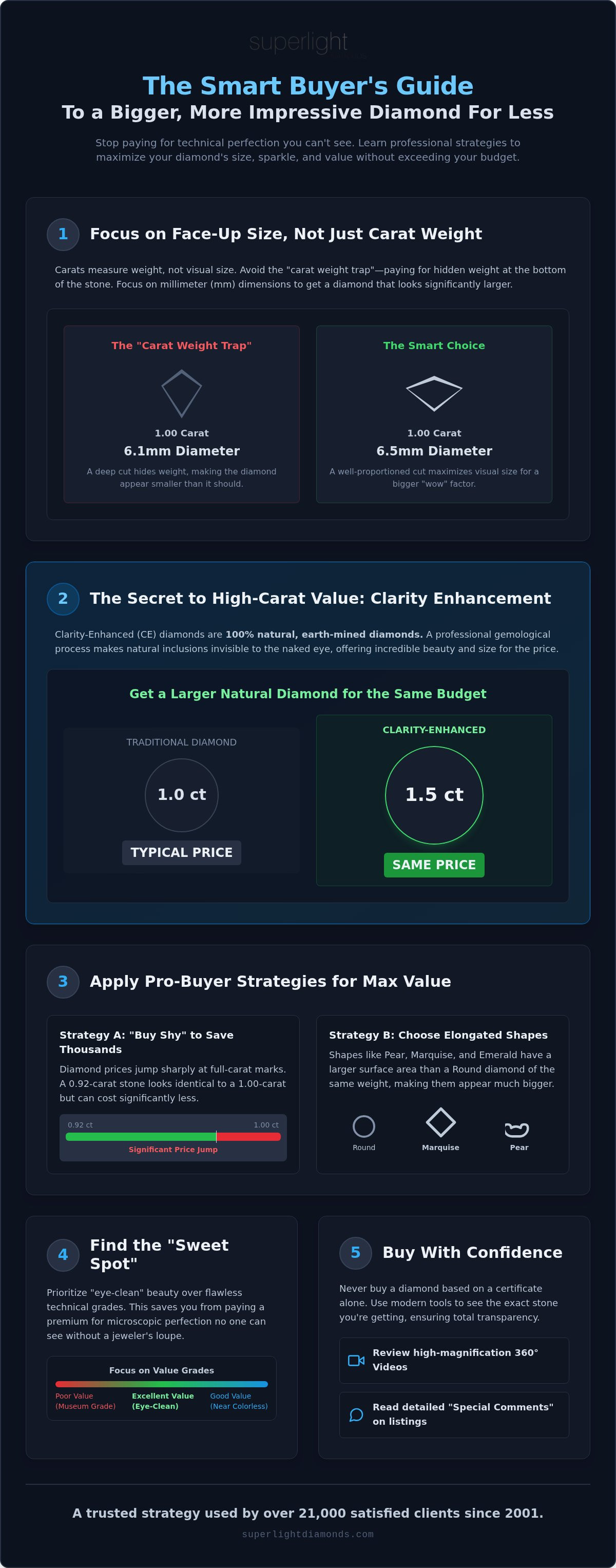
Most buyers equate carat weight with physical size, but carats actually measure weight, not how large the stone looks to the eye. Two diamonds with the exact same weight can appear drastically different when viewed from above. This visual measurement is known as "face-up size." To get a bigger diamond for less, you must understand that paying for weight does not always result in a larger appearance. When a diamond is cut too deep, a significant portion of its mass is tucked into the pavilion, which is the bottom part of the stone. This is often called the "carat weight trap." You pay for this hidden weight because diamond pricing is based on the scale, but that weight remains invisible once the stone is set in a ring.
One of the most effective ways to maximize your budget is a strategy known as "buying shy." Diamond prices often climb sharply at full-carat milestones like 1.00ct, 1.50ct, or 2.00ct. A 0.92-carat stone can look identical to a 1.00-carat stone to the naked eye, yet it costs significantly less. By choosing a stone that sits just below these popular weight thresholds, you can save thousands of dollars without any perceptible loss in visual impact. The key is to focus on the millimeter dimensions listed on the grading report rather than just the number on the scale. A stone with a larger diameter will always look more impressive than a heavier stone with a smaller surface area.
The Impact of Diamond Shape on Perceived Size
Elongated shapes like Pear, Marquise, and Emerald cuts offer a larger surface area than Round Brilliant diamonds of the same weight. For example, a 1-carat Marquise cut diamond typically has a much longer visual "spread" than a 1-carat Round, making it look much larger on the finger. Additionally, certain shapes like Radiant or Cushion cuts can be more forgiving with inclusions. This allows you to choose a lower clarity grade and redirect those savings toward a higher carat weight, helping you get a bigger diamond for less while maintaining a striking presence.
Prioritizing the 'Cut' Over Carat
The cut of a diamond determines its diameter and its brightness. A "spready" diamond is one that has been cut with proportions that maximize its face-up millimeter measurement. While you want to avoid stones that are so shallow they lose their sparkle, finding a well-proportioned cut that leans toward a larger diameter is essential. A bright, well-cut stone will always look more impressive than a dull, heavy one. We recommend reviewing 360 degree videos to ensure the stone has the necessary fire and brilliance to complement its size.
The Secret to High Carat Value: Clarity Enhanced Diamonds
Understanding clarity enhanced diamonds is essential for anyone looking to get a bigger diamond for less. These stones are 100% natural, earth-mined diamonds, not lab-grown alternatives or simulants. They formed deep within the earth over millions of years and possess the same physical and chemical properties as any other natural diamond. The only difference is that they have undergone a professional gemological process to minimize the appearance of natural inclusions, such as microscopic feathers. This treatment makes the inclusions invisible to the naked eye, resulting in a stone that looks remarkably clear and brilliant.
The price advantage of this strategy is significant. In many cases, a savvy buyer can secure a 1.5-carat clarity-enhanced stone for the same price as a 1-carat traditional stone with similar visual appeal. This approach allows you to bypass the steep markups associated with microscopic perfection that no one can see without a jeweler's loupe. By choosing enhancement, you focus your budget on what actually matters: the size, sparkle, and natural origin of your diamond. This is the most direct path to get a bigger diamond for less while maintaining the prestige of a natural gemstone.
Why Savvy Buyers Choose Enhancement
Savvy buyers prioritize "eye-clean" beauty over technical grading reports. By choosing an enhanced stone, you get a diamond that looks flawless to the naked eye without paying for the rarity of a naturally VVS-grade stone. For example, the cost of a 2 carat clarity enhanced diamond is often thousands of dollars less than its non-enhanced equivalent. This creates immense emotional value, as it puts large, impressive natural diamonds within reach of a practical budget. It's about maximizing the visual impact on the hand rather than the data on a certificate.
Durability and Care of Enhanced Stones
Modern enhancement techniques are stable and designed for a lifetime of daily wear. These stones are permanent solutions for jewelry and do not require specialized daily care beyond what you would give any fine natural diamond. It's helpful to know that enhanced stones should not be exposed to extreme heat, such as a jeweler's torch during a resizing, or certain boiling acids. Regular cleaning with mild soap and a soft brush will keep the stone's natural brilliance intact. We provide detailed "Special Comments" and 360 degree videos for every stone to ensure you buy with total confidence. If you want to see how these stones compare to traditional options, you might view our latest inventory of natural diamonds.
Strategic Grading: Where to Compromise Safely
Strategic grading is the art of identifying which technical specifications impact beauty and which only impact the price tag. Most consumers are led to believe that they need the highest possible grades to have a beautiful stone. In reality, you can get a bigger diamond for less by focusing on "eye-clean" standards rather than microscopic perfection. VVS clarity grades represent a level of purity that is invisible to the naked eye; paying for this rarity often drains a budget that could have been used to increase the diamond's carat weight. An eye-clean SI1 or SI2 diamond will look identical to a VVS stone in a daily setting but will cost significantly less.
Color grading follows a similar logic of diminishing returns. While D, E, and F grades are technically colorless, the G through J range is the professional "sweet spot" for value. These diamonds appear white to the casual observer once they are mounted in jewelry. At Superlight Diamonds, we utilize IGL (International Gemological Laboratories) certification to provide an objective assessment of these traits. This allows you to understand the exact characteristics of your stone without paying the "brand premium" often associated with other labs. We encourage our clients to use our 360 degree videos and highly magnified photography to verify the stone's appearance for themselves. Seeing the actual stone is always more important than the letters and numbers on a report.
Color and Metal Synergy
The metal you choose for your setting plays a significant role in how your diamond's color is perceived. If you select a yellow or rose gold band, the warm tones of the metal will naturally mask a lower color grade like I or J. This synergy allows you to get a bigger diamond for less because you can safely drop a few color grades without the stone looking "yellow." Conversely, a white gold or platinum setting can make a slightly warmer stone look crisp and bright. Some diamonds also feature blue fluorescence, which can actually make a lower-color stone appear whiter in natural sunlight, providing even more value for your budget.
The Fallacy of 'Museum Quality'
Avoid the trap of "museum quality" or "investment grade" marketing. These terms are designed for high-end collectors, not for someone who wants a stunning engagement ring to wear every day. Rarity does not always equal beauty. If your goal is a stone that catches the light from across the room, you should allocate your budget toward size and cut proportions rather than microscopic clarity. Focus on "commercial" grades that offer the best visual bang-for-your-buck. By letting go of the need for a "perfect" certificate, you open the door to a much larger and more impressive natural diamond.
How to Buy Diamonds at Auction Without Risk
Participating in no-reserve auctions is one of the most effective ways to bypass traditional retail markups. In a standard retail environment, you pay for a jeweler's overhead, marketing, and inventory costs. Auctions strip these layers away, allowing the market to set a fair price based on current demand. This transparency is a powerful tool for those who want to get a bigger diamond for less. However, the key to success lies in choosing the right platform and seller. You should prioritize sellers with a long-standing history, such as those with over 20 years of experience and a high volume of positive feedback. Superlight Diamonds has successfully served over 21,000 clients since 2001, maintaining a top-rated status that reflects a commitment to honest transactions.
Buying online requires a shift in how you evaluate a stone. You cannot rely solely on a grading certificate. A report might tell you the weight and color, but it won't show you the diamond's personality. High-magnification photography and detailed descriptions are essential for a risk-free purchase. We provide multiple angles and close-up views so you can inspect the stone as if you were holding it in your hand. This level of detail ensures that there are no surprises when the package arrives at your door.
Mastering the 360° Video Inspection
A 360 degree video is your most valuable asset when evaluating a diamond's "life" and "fire." While a certificate provides a technical snapshot, a video reveals how the stone interacts with light. Watch for the tilt of the diamond to see how the sparkle moves across the facets. This is especially important for clarity-enhanced stones, as it allows you to see exactly how eye-clean the diamond appears in motion. If a stone looks bright and lively in a video, it will look even better on your finger. We believe a video is often more informative than a grading report because it captures the visual reality of the stone.
Transparency and the 'Special Comments' Tool
We take transparency a step further by including a "Special Comments" section on every listing. This tool allows us to disclose characteristics that a standard grading report might overlook, such as the specific placement of an inclusion or the exact nature of the enhancement. Many first-time buyers ask, are clarity enhanced diamonds real? The answer is a definitive yes, and our transparent descriptions prove it. By providing honest, detailed accounts of every stone, we build the trust necessary for you to get a bigger diamond for less with total confidence. You can browse our current no-reserve auctions to see this transparency in action.
Building Your Value Strategy: The Final Checklist
To successfully get a bigger diamond for less, you must transition from a technical goal to a visual goal. A technical goal focuses on reaching a specific grade on a certificate, which often leads to overpaying for microscopic traits that no one can see. A visual goal, however, prioritizes how the stone actually looks on the hand. By combining elongated shapes, clarity enhancement, and market-driven auction bidding, you can secure a natural diamond that appears twice as expensive as its actual cost. This strategic approach ensures your budget is spent on visible impact rather than laboratory statistics.
Security is just as important as value. When you buy a diamond online, always verify the seller's return policy and satisfaction guarantee. A transparent seller will stand behind their inventory, allowing you to inspect the stone in person with the peace of mind that you can return it if it does not meet your expectations. This final layer of protection allows you to bid and buy with total confidence, knowing that your path to a high-carat natural stone is both savvy and safe.
Your 5-Point Value Checklist
- Step 1: Select an elongated shape. Prioritize Pear, Marquise, or Emerald cuts to maximize the "spread" or face-up surface area of the diamond.
- Step 2: Utilize clarity enhancement. Choose a natural earth-mined stone that has been professionally enhanced to boost your carat weight by 30% or more without increasing your spend.
- Step 3: Verify with IGL and 360° videos. Never rely on a report alone. Use highly magnified photography and video to confirm the stone is "eye-clean" and full of life.
- Step 4: Scout no-reserve auctions. Bypass traditional retail markups by participating in auctions where the market determines the final price.
- Step 5: Review the "Special Comments." Use these detailed notes to understand the unique characteristics of the specific diamond you are considering.
The Superlight Diamonds Advantage
We have spent over 20 years demystifying the diamond market for value-conscious consumers. Since 2001, we have helped more than 21,000 clients get a bigger diamond for less by providing a transparent, high-volume alternative to traditional luxury retail. Our expertise in IGL-certified, clarity-enhanced stones means you don't have to choose between a natural diamond and a large carat weight. We provide the tools, the data, and the proven history you need to make an informed decision and walk away with a beautiful stone at an honest price.
Ready to find your perfect stone? Explore our current no-reserve diamond auctions on eBay to see how much more diamond your budget can actually buy.
Secure Your Impressive Natural Diamond Today
Securing a stunning natural stone doesn't require a high-end collector's budget. By prioritizing face-up size and choosing clarity-enhanced options, you can effectively get a bigger diamond for less without sacrificing the natural beauty you desire. Remember to use transparency tools like 360 degree videos and detailed special comments to ensure your purchase matches your visual goals perfectly. These professional strategies allow you to bypass retail markups and focus your investment on the sparkle and size that truly matter.
Superlight Diamonds has provided veteran expert support since 2001, helping more than 21,000 satisfied clients find incredible value. As a top rated eBay seller, we're committed to making the diamond buying process clear, honest, and accessible. It's time to stop paying for microscopic traits and start investing in the brilliance you can actually see. We're excited to help you find a diamond that makes a lasting impression.
Maximize Your Budget: Shop Loose Diamonds Now
Frequently Asked Questions
Can I really get a natural diamond for 50% less than retail?
Yes, you can significantly reduce costs by choosing clarity-enhanced stones and participating in no-reserve auctions. Traditional retail prices include heavy markups for showroom overhead and marketing. By purchasing directly through high-volume market models, you bypass these costs. This strategy is the most effective way to get a bigger diamond for less while still owning a 100% natural, earth-mined stone.
Is a clarity-enhanced diamond a real diamond?
Clarity-enhanced diamonds are 100% natural earth-mined gemstones that have undergone a professional process to improve their visual purity. They are not lab-grown or simulants. The process involves filling microscopic feathers with a substance that has the same refractive index as a diamond, making natural inclusions invisible. These stones possess the same physical and chemical properties as any other natural diamond found in the earth.
What diamond shape looks the biggest for its weight?
Elongated shapes such as Marquise, Pear, and Emerald cuts offer the largest perceived size because they have a greater surface area or "spread." A 1-carat Marquise diamond will look much larger than a 1-carat Round Brilliant because its length covers more of the finger. Choosing these shapes is a smart tactical move for buyers who want to maximize the visual impact of their stone without increasing their budget.
Why should I buy a loose diamond instead of a pre-set ring?
Buying a loose diamond allows you to inspect the stone's quality without a setting hiding potential inclusions or flaws. It also gives you full control over your budget, as you can pair a high-value stone with a setting of your choice. This approach ensures total transparency, especially when you use 360 degree videos to examine the diamond from every angle before it is mounted.
How do I know if an online diamond auction is safe?
A safe auction seller should have a long history of successful transactions and thousands of positive reviews. Look for veteran experts who have been in business for over 20 years, like Superlight Diamonds. Safety also comes from transparency; ensure the listing includes highly magnified photography, video, and detailed "Special Comments" that disclose all characteristics of the stone. A clear return policy is also a vital indicator of a trustworthy seller.
Does a clarity-enhanced diamond look different to the naked eye?
To the naked eye, a clarity-enhanced diamond looks identical to a non-enhanced diamond with a higher clarity grade. The enhancement process is designed to make eye-visible inclusions disappear, resulting in a stone that appears clear and brilliant. This allows you to get a bigger diamond for less because you aren't paying for the technical rarity of a naturally flawless stone that looks the same.
Is GIA certification the only one I should trust?
While GIA is well-known, other laboratories like IGL (International Gemological Laboratories) provide objective and accurate grading for the value-conscious market. IGL certification is particularly common for clarity-enhanced diamonds. The most important factor in any purchase is the transparency of the seller. You should always supplement a grading report with actual images and 360 degree videos of the specific diamond to verify its beauty for yourself.
How much can I save by 'buying shy' of a full carat?
Buying shy can save you significant amounts of money because diamond prices jump at full-carat milestones. For instance, a 0.90-carat stone can cost much less than a 1.00-carat stone, yet they look virtually identical once set in a ring. Since the price per carat increases at the 1.00ct mark, choosing a stone just below that weight is a proven way to maximize your budget.