Loading... Please wait...
 USD
USD


Blog
Recent Posts
Loose Diamond Wholesale Price Guide: How to Secure Real Value in 2026
Posted on

What is a fair loose diamond wholesale price, and how can you tell whether a diamond is good value? Rather than focusing only on microscopic grades or a “wholesale” label, compare the details that affect the stone’s appearance and check how clearly the seller shows the exact diamond. Traditional jewelry stores can leave buyers wondering how much of the price reflects the diamond and how much reflects the retail experience. Buying online raises a different question: what does the stone really look like?
At Superlight Diamonds, we specialize in natural earth-mined diamonds only. Clarity enhancement offers a practical way to choose a larger, beautiful stone within budget. This guide explains how to compare diamond details, weigh visible beauty against fine grading distinctions, and consider one- or two-carat options without paying extra for differences you may not notice. You’ll also learn how to review IGL certification alongside magnified photographs, 360° videos, and the listing’s “Special Comments” for the exact diamond. With more than 20 years of experience and over 21,000 satisfied clients, we believe transparency helps you buy with confidence.
Key Takeaways
- Compare a diamond’s details and appearance rather than relying on a “wholesale” label alone.
- Clarity enhancement can make a natural earth-mined diamond’s inclusions less visible, helping you prioritize visual appeal and size within your budget.
- Use this loose diamond wholesale price guide to assess value through clear disclosures, certification, and images of the exact stone.
- No-reserve auctions let bidding determine the final price. Review the diamond’s IGL certification, magnified photos, 360° video, and Special Comments before bidding.
Defining Loose Diamond Wholesale Price vs. Retail Markup
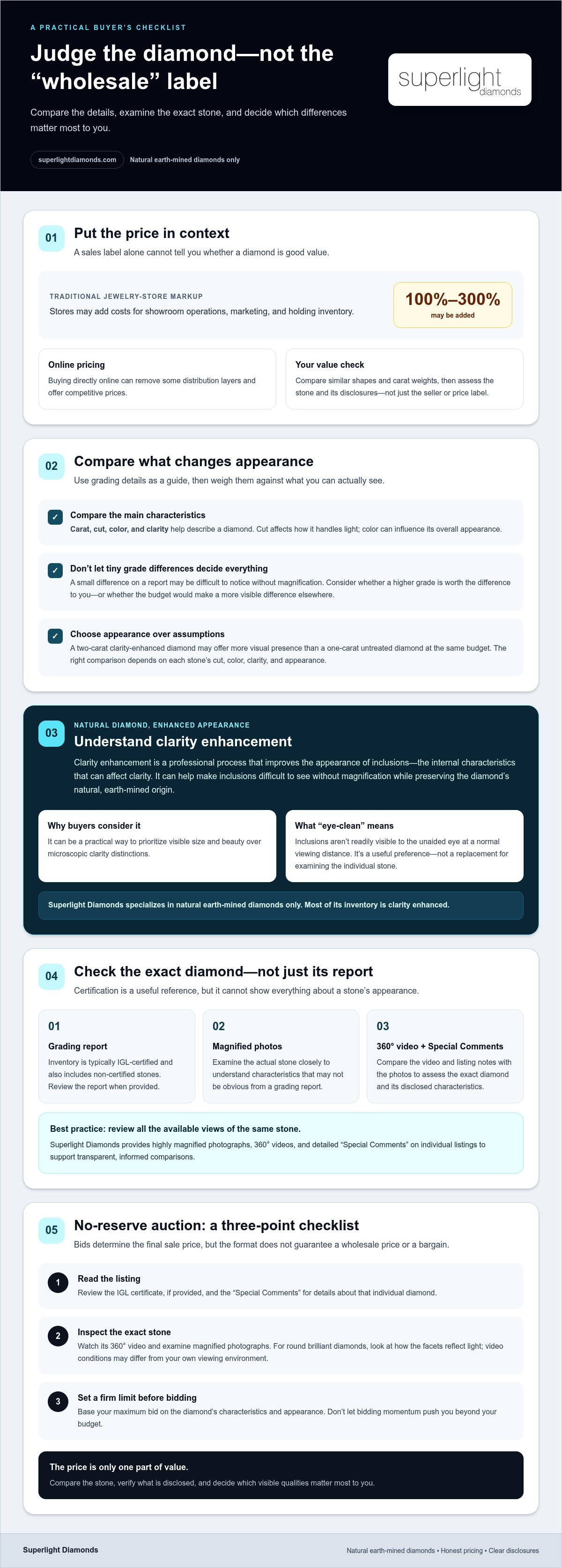
A loose diamond wholesale price generally refers to a price closer to trade-level pricing, before some retail costs are added. Traditional jewelry stores may add a 100% to 300% markup to cover expenses such as showroom operations, marketing, and holding inventory. Pricing varies between sellers, so compare the diamond itself and the information provided, not just the sales channel. Buying directly online can remove some distribution layers and offer natural earth-mined diamonds at competitive prices.
At Superlight Diamonds, we specialize in natural earth-mined diamonds only, with a focus on honest pricing and clear disclosures. A “wholesale” label alone doesn’t prove that a stone is good value. Compare diamonds with similar shapes and carat weights, then consider cut, color, clarity, certification, and the actual appearance of each stone to understand what you’re paying for.
Why Microscopic Grading Shouldn’t Dictate Your Entire Budget
Diamond grades describe characteristics such as carat, cut, color, and clarity, but a small difference on a report may be difficult to notice without magnification. Understanding these diamond quality characteristics can help you decide where your budget will make the greatest visible difference. Cut affects how a diamond handles light, while color can influence its overall appearance. Explore our guide to the diamond color scale to see how color grades compare.
Certification offers a useful grading reference, but it cannot show you everything about how a diamond looks in person. Superlight Diamonds’ inventory is typically IGL-certified, and also includes non-certified stones. Review the report alongside magnified photographs, 360° video, and the listing’s “Special Comments” for details about the exact diamond. Comparing these materials can help you decide whether a higher grade is worth the difference to you, or whether you would rather put that budget toward size or another visible feature.
Maximizing Value with Clarity Enhanced Natural Diamonds
Clarity enhancement is a professional process that improves the appearance of inclusions, the internal characteristics that can affect a diamond’s clarity. In an enhanced natural diamond, inclusions may become difficult to see without magnification, creating an eye-clean appearance while preserving the stone’s natural, earth-mined origin. At Superlight Diamonds, we specialize in natural earth-mined diamonds only, and most of our inventory is clarity enhanced.
This can be a practical way to prioritize visible size and beauty over microscopic clarity distinctions. For example, if two diamonds fit the same budget, a two-carat enhanced stone may offer more visual presence than a one-carat untreated stone. The right comparison depends on each diamond’s cut, color, clarity, and appearance, so look at the exact stones rather than assuming carat weight alone determines beauty.
The Savvy Buyer’s Guide to Clarity Enhanced Diamonds
For everyday wear, “eye-clean” describes a diamond whose inclusions aren’t readily visible to the unaided eye at a normal viewing distance. It can be a useful preference, but it isn’t a substitute for reviewing the grading information and the individual stone. Our clarity enhanced diamond guide explains what to consider.
Look beyond the certificate. Superlight Diamonds provides magnified photographs, 360° videos, and “Special Comments” on individual listings to help you examine the exact diamond and understand its characteristics. Review the same stone across the images, video, and listing details. This transparency helps you decide whether its appearance suits your priorities.
Some auction houses also use no-reserve formats, as illustrated by this no-reserve auction announcement from Sotheby’s. To explore natural clarity enhanced diamonds, browse the selection at Superlight Diamonds.
How to Secure Wholesale Prices via No-Reserve Auctions
A no-reserve auction has no minimum starting price set by the seller, so bids determine the final sale price. This offers a market-driven way to buy, but the final bid isn’t automatically a wholesale price or a guaranteed bargain. Before bidding, decide what the specific diamond is worth to you based on its details and appearance, rather than assuming the auction format sets its value.
Superlight Diamonds sells diamonds through no-reserve auctions and has served over 21,000 customers. Our top-rated eBay seller status reflects an established track record, while listing details help buyers assess each natural earth-mined diamond before bidding. Review the grading report and the diamond quality factors that influence a stone’s appearance and value. Our inventory is typically IGL-certified, and no single grading report replaces viewing the actual diamond.
Steps to Winning a No-Reserve Diamond Auction
- Read the listing first. Review the IGL certificate, if provided, and “Special Comments” for details about the individual stone.
- Inspect the exact diamond. Watch its 360° video and examine magnified photographs. For round brilliant loose diamonds, look closely at how the facets reflect light, while remembering that video conditions may differ from your own viewing environment.
- Set a firm limit. Compare the diamond’s characteristics and appearance, then decide your maximum bid before the auction. Don’t let bidding momentum push you beyond your budget.
For a fuller bidding walkthrough, read our no-reserve diamond auction guide. A considered bid, informed by the actual stone rather than retail expectations, can help you pursue a loose diamond wholesale price with confidence. Explore natural earth-mined diamonds at Superlight Diamonds.
Make Your Next Diamond Purchase with Confidence
A fair loose diamond wholesale price depends on more than a “wholesale” label. Compare the grading details with the diamond’s actual appearance, and consider whether clarity enhancement could help you prioritize visible beauty and size within your budget. No-reserve auctions offer another way to bid with a clear spending limit, while the auction determines the final price.
Superlight Diamonds specializes in natural earth-mined diamonds only, with more than 20 years of experience and over 21,000 satisfied clients. Magnified photographs, 360° videos, and “Special Comments” on individual listings help you examine the exact stone alongside its certification. Transparent details make it easier to choose a diamond that fits your preferences and budget.
Browse natural diamonds at Superlight Diamonds. Take your time, review the details, and choose the stone that feels right for you.
Frequently Asked Questions
Can individuals buy diamonds at wholesale prices?
Yes, individuals can buy loose diamonds through direct-to-consumer sales and no-reserve auctions without being professional jewelers. At Superlight Diamonds, customers can compare fixed-price natural diamonds and participate in eBay auctions. A loose diamond wholesale price isn’t guaranteed by a label or auction format, so review the stone’s certification, specifications, and listing details before deciding what it’s worth to you.
What is the difference between an IGL and GIA certificate in terms of price?
An IGL or GIA grading report doesn’t set a diamond’s price by itself. The report describes characteristics such as carat weight, color, clarity, and cut, while the stone’s appearance and the seller’s pricing model also matter. Superlight Diamonds offers IGL-certified inventory, as well as some non-certified stones. Compare each diamond’s documentation and actual visuals rather than assuming one certificate guarantees a specific price.
Is a clarity-enhanced diamond a real natural diamond?
Yes. A clarity-enhanced diamond is a natural earth-mined diamond that has undergone a professional process to improve the appearance of inclusions. The treatment doesn’t change its natural origin. Superlight Diamonds specializes in natural earth-mined diamonds only, and most of our inventory is clarity enhanced. Review the listing’s certificate and disclosures to understand the specific stone and its characteristics.
Why are no-reserve auctions considered the “true” market price?
A no-reserve auction lets bidding determine the final sale price without a seller-set minimum, so the result reflects what participating bidders are willing to pay at that time. It’s a useful market signal, but not a universal or guaranteed “true” value. The final bid can vary with the diamond, its documentation, and auction participation. Set a maximum based on your own assessment before bidding.
What should I look for in “Special Comments” on a diamond listing?
Read “Special Comments” for details that may not be obvious from a grading report, including characteristics visible in magnified images or other information about the individual stone. Use the comments alongside the certificate, magnified photographs, and 360° video. These details help you understand the diamond’s appearance before you bid or buy, rather than relying on a grade alone.
How do magnified photos help determine a diamond’s wholesale value?
Magnified photos let you inspect the exact diamond for visible inclusions and other characteristics that may affect its appearance. They don’t establish wholesale value on their own, but they add visual context to the grading report and help you compare stones. Review the photos alongside the 360° video, certification, and listing comments to make a more informed assessment of the diamond’s value.
Loose Diamond Wholesale Price Guide: How to Secure Real Value in 2026
Why should a microscopic inclusion you can't see without a professional loupe add thousands of dollars to your invoice? Most buyers feel overcharged by traditional stores and confused by technical grading that doesn't match a stone's visual beauty. It's frustrating when a 1 or 2-carat stone is priced out of reach due to "invisible" specs. [...]