null

Additional Information

Site Information

Blog
 Loading... Please wait...

Blog

Loose Diamond Buying Mistakes: 10 Pitfalls to Avoid in 2026

Posted on

Loose Diamond Buying Mistakes: 10 Pitfalls to Avoid in 2026

The biggest mistake you can make isn't choosing the wrong grade on a certificate; it's paying for microscopic perfection you'll never see with the naked eye. Most shoppers feel a deep sense of anxiety when they see two identical-looking stones with vastly different price tags. You want a natural diamond that captures the light and commands attention, but you're likely worried about falling for common loose diamond buying mistakes that lead to overpaying for "paper" quality. With natural diamond prices stabilizing in early 2026 after the fluctuations of 2025, it's more important than ever to understand where your money actually goes.

We're here to change your approach by showing you how to prioritize sparkle and size over invisible lab ratings. You'll discover the professional secrets to securing a larger, more impressive natural diamond by understanding the value of clarity enhancement and transparent disclosure. This guide covers the ten critical pitfalls to avoid in 2026, from over-reliance on specific grading labs like the IGL to the danger of buying without seeing actual 360-degree videos and "Special Comments" on a listing. By the end, you'll have the confidence to bypass the retail tax and find a stunning, earth-mined stone that fits your real-world budget.

Key Takeaways

  • Identify why 360-degree videos and magnified photos are essential to avoid common loose diamond buying mistakes that grading certificates alone cannot reveal.
  • Learn how to prioritize visual beauty over microscopic perfection by selecting "near colorless" grades that look identical to premium stones once they are set in jewelry.
  • Discover the benefits of clarity-enhanced natural diamonds as a transparent and effective way to secure a larger, more eye-catching stone within your specific budget.
  • Understand the importance of reviewing "Special Comments" and high-definition media to ensure the diamond you see online is exactly what arrives at your door.
  • Find out how to bypass traditional showroom markups by leveraging objective IGL certification and market-driven pricing for significantly better overall value.

The 'Paper vs. Performance' Trap: Why Certificates Aren't Everything

Many shoppers treat a diamond certificate like a medical diagnosis, believing that a specific set of letters and numbers guarantees a sparkling result. This assumption is one of the most common loose diamond buying mistakes. A grading report is a record of technical specifications, but it doesn't measure the "life" or personality of the stone. Buying a diamond "blind" based only on a PDF report often leads to disappointment because two stones with the exact same grades can look radically different in person. Certification should be viewed as a tool for transparency rather than a final verdict on beauty.

Grading Labs: Beyond the GIA Monolith

The jewelry industry often pushes the GIA as the only acceptable authority, but this creates a "GIA premium" that value-conscious buyers don't always need to pay. While the GIA is a respected institution, labs like IGL (International Gemological Laboratories) provide the objective data you need to make an informed choice without the high-end markup associated with luxury branding. It's helpful to understand diamond quality fundamentals through these reports, but you should use the certificate as a baseline rather than a final decision. By choosing a lab that focuses on market-driven value, you can allocate more of your budget toward a larger carat weight or better visual performance.

The Limitations of a Grading Report

A certificate is a two-dimensional map of a three-dimensional object. It can't describe the luster of a stone or whether it appears "milky" or "cloudy" due to the specific nature of its inclusions. These visual factors are critical to how the diamond interacts with light. You might find a stone with a high clarity grade that looks dull because of poor light return, while a clarity-enhanced diamond with a lower technical grade looks bright and vibrant to the naked eye. This is why we prioritize visual transparency through actual photos and videos over paper stats alone.

For the savvy consumer, eye-clean is the true standard of quality; it means the diamond has no inclusions visible to the naked eye, allowing you to maximize size and sparkle without paying for microscopic perfection.

Overpaying for Microscopic Perfection: The 4Cs Value Mistakes

Many buyers fall into the trap of purchasing "paper quality" rather than visual beauty. This is one of the most expensive loose diamond buying mistakes. Chasing perfection on a grading report often leads to a smaller, less impressive stone that costs significantly more. By understanding where to compromise and where to invest, you can maximize the physical presence of your diamond without sacrificing the sparkle that defines a natural stone. The goal is to find a stone that looks magnificent on the finger, not just on a certificate.

Clarity: Eye-Clean vs. Loupe-Clean

Paying for Flawless (FL) or Internally Flawless (IF) clarity is rarely a wise move for a wearer. These grades describe perfection under 10x magnification, which is a standard no human eye can meet in daily life. Most SI1 and SI2 diamonds are "eye-clean," meaning their inclusions are invisible without a jeweler's loupe. These small, natural characteristics drop the price significantly while leaving the diamond's beauty intact. Clarity-enhanced natural diamonds are particularly effective here. They allow you to own a stone that looks like a high-clarity grade for a fraction of the cost, making it possible to afford a much larger natural diamond for your budget.

Color: When Does it Actually Matter?

The "D" color grade carries a massive price premium because it's technically colorless. However, once a diamond is set in a ring, "Near Colorless" stones (G through J) look virtually identical to the naked eye. Your choice of metal plays a huge role here. If you're using a yellow or rose gold setting, the metal's warmth will reflect through the stone anyway, making a "D" grade a waste of money. Even in white gold or platinum, an "I" or "J" color stone provides outstanding value and allows you to put those savings into a larger carat weight.

The final piece of the value puzzle is the relationship between carat weight and cut. A common error is buying a 1.5-carat stone that is cut too deep. This "hidden" weight stays in the bottom of the stone where you can't see it, making it look smaller than a well-proportioned 1.2-carat diamond. A stone with the right proportions will have a larger surface area and better light return. To see how these factors come together in person, you can browse actual photos of natural diamonds to find the perfect balance of size and sparkle. Balancing these factors is about trade-offs; by lowering the color and clarity slightly, you can often double the visual impact of the stone's size.

Ignoring Visual Transparency: The Danger of Generic Stock Photos

One of the most avoidable loose diamond buying mistakes is purchasing a stone based on a "sample" image. Many online retailers use stock photography that represents a general grade rather than the specific diamond you'll receive. Because no two natural diamonds are identical, a stock photo hides the unique character and potential flaws of your stone. Visual transparency is the only way to ensure that the stone you see on your screen matches the one that arrives at your door. Relying solely on a certificate without seeing the actual diamond is a gamble you don't need to take.

Demanding the 'Actual Stone' View

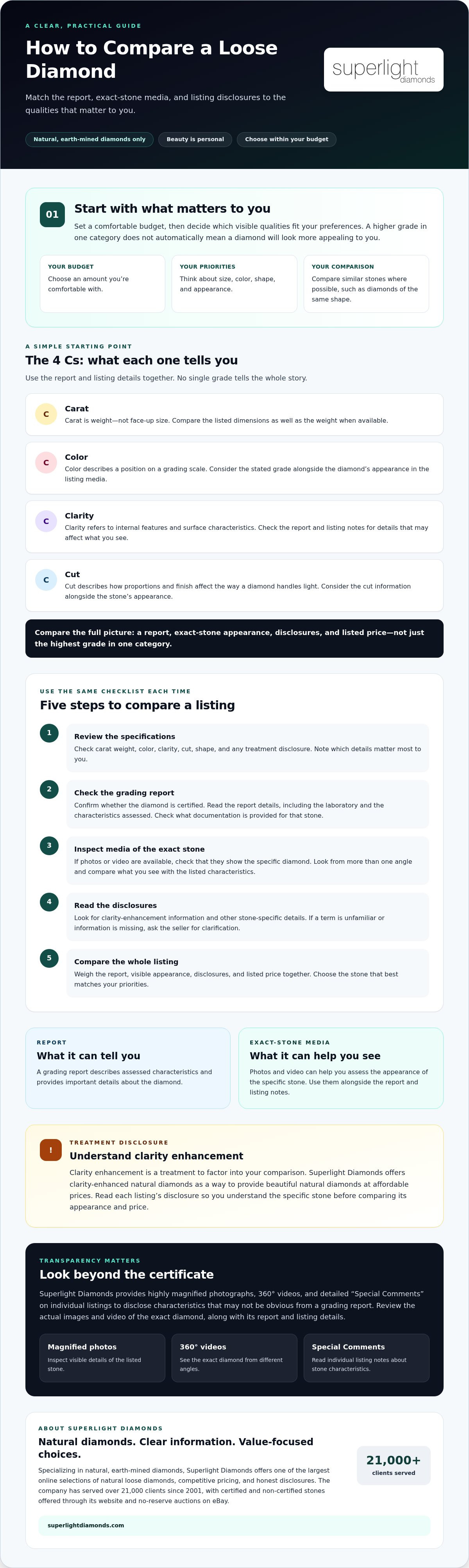
You should always look for listings that provide high-definition, 360-degree videos of the exact diamond. These videos allow you to see how the stone reacts to light from every angle. You can check for "dead spots" where light doesn't reflect properly or identify exactly where inclusions are located. High-magnification photography, often ranging from 20x to 40x, reveals the stone's true personality. While a grading report might list an inclusion, a magnified photo shows you if that inclusion is a dark crystal in the center or a faint feather near the edge. This level of detail is essential for a confident online purchase.

The Power of 'Special Comments'

While technical maps and light performance charts have their place, they often miss the practical details that matter to a consumer. This is why we prioritize "Special Comments" on every listing. These comments act as a direct line of communication from the expert to you. They disclose characteristics that a standard IGL certificate might not highlight, such as whether a stone is truly "eye-clean" or has a "slight tint" that offers a better price point. These details help you understand the visual reality of the stone beyond the technical jargon.

These disclosures build a bridge of trust. For over 20 years, we've used this transparent approach to help more than 21,000 clients find exceptional value. Instead of guessing how a stone looks based on a chart, you get a clear, honest description of its visual impact. This transparency is especially important for clarity-enhanced natural diamonds. By disclosing the enhancement process and providing actual visuals, we ensure you understand exactly why you're getting a larger, more beautiful stone for a significantly lower price. Trust is built on what you can see, not just what you can read.

Loose diamond buying mistakes

Falling for Retail Markups: The 'Showroom' Mistake

Many shoppers believe that a high price tag in a luxury boutique is a guarantee of superior quality. This is one of the most common loose diamond buying mistakes. In reality, retail prices are often inflated by 300% or more to cover the massive overhead of brick-and-mortar showrooms. When you buy from a traditional jeweler, you aren't just paying for the stone; you're paying for their prime real estate, high-intensity lighting, and commissioned sales teams. These theatrical costs add nothing to the actual beauty or sparkle of your diamond.

Wholesalers who operate online eliminate these unnecessary expenses. By moving a high volume of stones, they can maintain lower margins and provide natural diamonds at prices that are much closer to the source. This direct-to-consumer model ensures that every dollar of your budget goes toward the physical stone rather than a retailer's rent or utility bills.

Auctions vs. Fixed Price: Which Wins?

While many sites offer fixed pricing, no-reserve auctions are the ultimate tool for market-driven value. This format allows the buyer to decide what a diamond is worth, rather than accepting a predetermined retail markup. To succeed in this environment, it's vital to avoid emotional bidding. You should set a hard limit based on your research and stick to it. If you're new to this process, reading a guide on Mastering the No Reserve Diamond Auction can help you navigate the process with confidence. This transparent approach ensures you never pay more than the current market is willing to bear.

The Wholesale Advantage

Experience matters when you're looking for value. Buying from a company with over 20 years of high-volume experience means you're benefiting from established supply chains and deep industry expertise. A wholesaler that has served over 21,000 satisfied clients since 2001 understands how to identify stones that offer the best visual performance for the price. Superlight Diamonds leverages its significant scale and rapid inventory turnover to secure primary-source pricing, allowing it to pass substantial savings directly to you.

Choosing a wholesaler with a top-rated status on platforms like eBay provides an extra layer of security. It shows a long history of transparency and reliable delivery. Instead of paying for a fancy blue box or a glass of champagne in a showroom, you get a larger, more impressive natural diamond. You can view our current diamond auctions to see how market-driven pricing compares to traditional retail markups.

Dismissing Clarity Enhancement: Missing the Value Opportunity

Excluding clarity-enhanced stones from your search is a frequent entry in the list of loose diamond buying mistakes. Many shoppers operate under the false impression that these stones are "fake" or "synthetic." In reality, clarity-enhanced diamonds are 100% natural, earth-mined stones that simply possess unique characteristics that have been visually improved. By dismissing this category, you're often turning your back on the most effective way to maximize your budget and secure a significantly larger diamond.

The Truth About the Enhancement Process

The enhancement process is a transparent and honest method used to make natural inclusions invisible to the naked eye. It involves a microscopic filling of feathers or reached inclusions with a substance that has a similar refractive index to the diamond itself. This doesn't change the diamond's weight or its chemical composition; it simply allows light to pass through the stone without being interrupted by a visible flaw. For buyers who want size and sparkle without the five-figure price tag associated with top-tier clarity grades, this is a genuine win-win scenario.

It's vital to understand that this is a visual upgrade for a natural product. You can learn more about the technical details and long-term care in our Clarity Enhanced Diamonds: The Savvy Buyer’s Guide. This transparency ensures you know exactly what you're buying while benefiting from the substantial price difference compared to traditional stones.

Consider the visual impact of your choice. For the same budget that might only purchase a 1-carat traditional diamond with an "eye-clean" grade, you can often secure a 2-carat clarity-enhanced natural diamond. On the finger, the difference is undeniable. The 2-carat stone offers a much larger surface area and a more commanding presence, providing a "wow" factor that a smaller stone simply cannot match, regardless of its technical clarity grade.

Maximizing the 'Wow' Factor

Everyday consumers should focus on diamonds that are visually impressive rather than chasing "investment grade" labels that offer little practical benefit. Unless you're a high-end collector, the emotional value of your purchase comes from the brilliance and scale of the stone when it's worn and admired. A larger natural diamond captures more light and creates more fire, which is what people actually notice in real-world settings.

Before you make your final decision, run through this value-focused checklist:

  • Prioritize the diamond's actual sparkle and light return over its technical rarity.
  • Review 360-degree videos to ensure the stone is eye-clean.
  • Choose a larger carat weight that fits your budget by opting for "Near Colorless" and clarity-enhanced options.
  • Ensure you're buying from a wholesaler with a proven track record of transparency and satisfied clients.

Ultimately, the best diamond isn't the one with the rarest technical stats on a piece of paper. It's the natural, earth-mined stone that fits your budget while providing the maximum amount of beauty and brilliance for the person wearing it.

Secure Your Perfect Natural Diamond with Confidence

Finding the right stone doesn't have to be a source of stress. By shifting your focus from microscopic paper grades to real-world visual beauty, you can bypass the most expensive loose diamond buying mistakes. Remember that an eye-clean, clarity-enhanced stone often provides a much larger and more brilliant impact than a smaller, flawless diamond that stays hidden in a safe. True value is found in 100% natural earth-mined diamonds that look magnificent on the finger, not just on a certificate.

Transparency is the foundation of a successful purchase. Always demand magnified 360° videos and detailed special comments to ensure you know exactly what you're buying. With over 21,000 happy customers since 2001, we've proven that you don't need a luxury showroom budget to own a stunning natural diamond. You now have the knowledge to make a savvy decision that prioritizes sparkle and size over retail markups.

Browse our No-Reserve Diamond Auctions and save up to 50% on retail prices to find the stone you've always wanted at an honest price. Your journey to owning a beautiful, high-carat natural diamond starts with these transparent insights.

Common Questions About Buying Loose Diamonds

Is it a mistake to buy a diamond without a GIA certificate?

Assuming the GIA is the only reliable grading lab is one of the most frequent loose diamond buying mistakes. While the GIA is a respected institution, labs like IGL (International Gemological Laboratories) provide objective, technical grading that ensures you aren't paying a luxury brand premium. The key is to use the certificate as a baseline and then verify the stone's beauty through actual 360-degree videos and magnified photographs.

Are clarity-enhanced diamonds a bad idea for an engagement ring?

Clarity-enhanced natural diamonds are an excellent choice for engagement rings because they allow you to maximize size and sparkle within a realistic budget. These are 100% natural earth-mined diamonds. The enhancement process simply makes natural inclusions invisible to the naked eye. This results in a larger, more eye-catching stone that looks magnificent on the finger without the five-figure price tag of traditional high-clarity grades.

How can I tell if a loose diamond is 'eye-clean' when buying online?

You can't determine if a stone is eye-clean from a grading report alone. To be certain, you must review high-definition 360-degree videos and magnified photos of the actual stone. We provide these for every listing to ensure transparency. If inclusions aren't visible in a 20x or 40x magnified video, the stone will be completely eye-clean to the naked eye once it is set in jewelry.

Is buying a loose diamond on eBay risky?

Buying on eBay is a secure process if you select a veteran seller with a proven track record. It's important to look for top-rated status and a high volume of positive feedback. Since 2001, we've served over 21,000 satisfied clients using a transparent model. Risk is eliminated when the seller provides actual media of every stone and offers clear, honest disclosures in the listing comments.

What is the biggest mistake people make with the 4Cs?

The most common error is overpaying for microscopic perfection that offers no visual benefit. Many buyers chase "D" color or "Flawless" clarity, even though these grades look identical to "I" color or "SI" clarity stones to the naked eye. By balancing the 4Cs and compromising on technical grades you can't see, you can afford a much larger natural diamond with superior sparkle.

Why should I avoid 'Excellent' cut claims that aren't verified by actual images?

Technical cut grades on a certificate don't always translate to real-world brilliance. Some stones with high cut grades still have "dead spots" or poor light return due to their specific proportions. You should always demand visual proof through 360-degree videos. Seeing how the light actually moves through the stone is the only way to guarantee the fire and brilliance you're paying for.

Can I save money by buying a diamond with a lower color grade?

Selecting a "Near Colorless" grade like G through J is a professional secret to saving thousands. These stones look white in most settings, especially yellow or rose gold. This strategy helps you avoid loose diamond buying mistakes like paying for aTechnical "D" color premium that is unnoticeable to the naked eye. This allows you to put your budget toward a larger carat weight instead.

What should I look for in 'Special Comments' on a diamond listing?

"Special Comments" are essential because they disclose visual traits that a standard certificate might miss. These notes often confirm if a stone is truly eye-clean or describe the specific nature of its luster. Reading these comments is a vital step in buying with confidence. They provide a professional assessment of the stone's visual character, ensuring you have a complete and honest picture of the diamond's beauty.

View Comments