Loading... Please wait...
 EUR
EUR



Blog
Recent Posts
How to Inspect Loose Diamonds With a 10x Loupe: A Step-by-Step Guide
Posted on

A mark that catches your eye under a loupe may tell you less about a diamond than you think. A 10x view brings small inclusions and surface features into focus, but it can’t tell you on its own whether a stone is right for you. Learning how to inspect loose diamonds with a 10x loupe gives you a consistent way to look closely without treating every visible feature as a problem.
At Superlight Diamonds, we specialize only in natural, earth-mined diamonds. Most of our selection is clarity-enhanced, a process that improves the appearance of natural diamonds and helps make them more affordable. This guide explains how to hold and focus a loupe, follow a repeatable inspection, and distinguish possible inclusions from surface marks and reflections. You’ll also learn what magnification can and can’t establish, and how to compare your observations with a grading report and the exact stone’s highly magnified photos, 360° video, and Special Comments.
Key Takeaways
- Learning how to inspect loose diamonds with a 10x loupe gives you a consistent way to examine a stone, but magnification alone can’t determine its overall quality.
- Inspect the diamond in sequence, moving from the table and crown to the girdle and pavilion. Refocus as you change your view.
- Compare what you see with the grading report and the exact diamond’s photos and video before deciding whether a feature matters to you.
- Superlight Diamonds specializes only in natural, earth-mined diamonds, including clarity-enhanced stones that offer beauty and value.
What a 10x Loupe Can, and Cannot, Show You About a Loose Diamond
A 10x loupe is a small magnifier that makes a diamond appear ten times larger, revealing details that are difficult to see with the unaided eye. It’s useful for close visual inspection, and 10x magnification is commonly used when assessing diamond clarity. However, seeing a feature doesn’t tell you its grade or, by itself, whether it affects the diamond’s beauty.
A loupe observation describes what you see; a clarity grade is a formal assessment of a feature’s type, size, position, and visibility. Keeping that difference in mind is central to learning how to inspect loose diamonds with a 10x loupe without treating every tiny mark as a reason to reject a stone. For an overview of the terminology, see Diamond clarity.
What counts as an inclusion, blemish, or reflection?
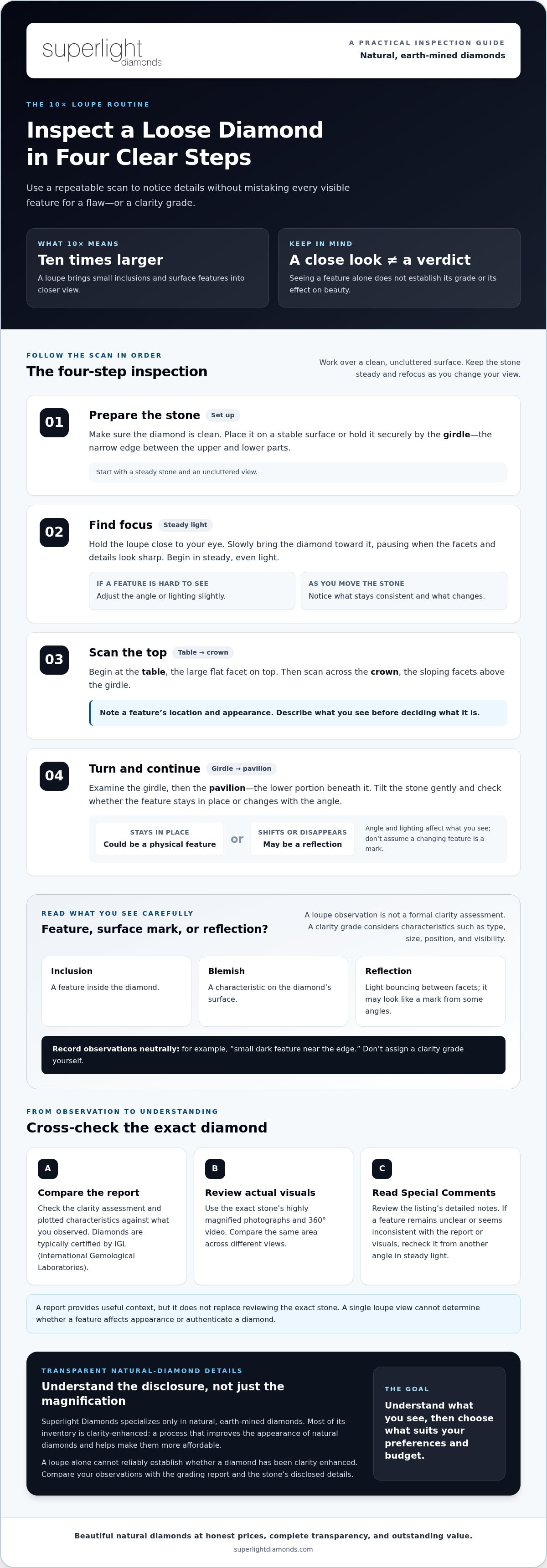
An inclusion is a feature inside the diamond; a blemish is a characteristic on its surface. A reflection is light bouncing between the diamond’s facets, and from some angles it can look like a mark. Lighting and viewing angle affect what you see. If a feature seems to shift or disappear as you reposition the stone, don’t assume immediately that it’s a physical mark.
A loupe also can’t reliably authenticate a diamond or establish whether it has been clarity enhanced. Enhancement can improve a natural diamond’s appearance, but visual inspection alone isn’t a dependable way to identify treatment. Superlight Diamonds specializes only in natural, earth-mined diamonds, and most of our inventory consists of clarity-enhanced natural diamonds. Compare your observations with the grading report and the diamond’s disclosed details. Magnification is one useful part of a transparent decision, not a complete verdict.
How to Inspect a Loose Diamond With a 10x Loupe Step by Step
A consistent routine makes it easier to distinguish a physical feature from a reflection that changes as you move the diamond. Work over a clean, uncluttered surface and keep the stone steady while you inspect it.
How do you hold and focus a 10x diamond loupe?
Hold the loupe close to your eye, steady your hands, and bring the diamond toward the loupe until the view sharpens. Begin in steady, even light. If a feature is difficult to see, adjust the angle or lighting slightly and observe whether it changes. No single lighting setup reveals every detail, so pay attention to what stays consistent as you move the stone.
- Prepare the stone. Make sure it’s clean, then place it on a stable surface or hold it securely by the girdle, the narrow edge between the upper and lower parts.
- Find focus. Keep the loupe near your eye and move the diamond slowly toward it. Pause when the facets and details come into sharp view.
- Scan the top. Start at the table, the large flat facet on top, then look across the crown, the sloping facets above the girdle. Note a feature’s location and appearance without deciding straight away what it is.
- Turn and continue. Examine the girdle, then view the pavilion, the lower portion beneath it. Tilt the stone gently and check whether a feature stays in place or changes with the angle. This can help you tell a surface feature from a reflection.
Record what you see in neutral terms, such as “small dark feature near the edge,” rather than assigning a clarity grade. The GIA Diamond Clarity Grading resource explains how professionals assess clarity using multiple characteristics. Superlight Diamonds specializes only in natural, earth-mined diamonds and provides detailed information about individual stones to support careful review. Explore our natural loose diamonds with the same measured approach.
Turn Loupe Observations Into a More Confident Diamond Decision
Use your loupe notes as observations to compare, not as a grade you assign yourself. Check the grading report for its clarity assessment and plotted characteristics, then see whether the features’ locations and appearance broadly match what you observed. Diamonds are typically certified by IGL (International Gemological Laboratories). A report provides useful context, but it doesn’t replace reviewing the exact stone. The IGI Diamond Clarity Guide offers additional background on how clarity is assessed.
Next, review the diamond’s own highly magnified photographs, 360° video, and detailed Special Comments. Compare the same area across different views. A mark that looks prominent through a loupe may be less noticeable as the stone moves, while a feature described in the listing can be easier to identify once you know where to look. Superlight Diamonds provides these details for each diamond to support transparent decisions.
When should a loupe observation prompt a closer review?
Take a closer look if a feature remains unclear, appears different from the listing visuals, or doesn’t seem to match the report. Recheck it from another angle and in steady light before drawing a conclusion. A single glance can’t establish whether a feature affects the diamond’s appearance or determine whether it has been clarity enhanced. Most of our inventory consists of clarity-enhanced natural diamonds. This process can improve appearance and make beautiful natural diamonds more affordable, so review the disclosure and the Clarity-Enhanced Diamonds Buyer’s Guide for more context.
For a broader checklist beyond clarity, a Guide to Buying Round Brilliant Loose Diamonds Online can help you weigh a stone’s overall appearance and details. The goal of learning how to inspect loose diamonds with a 10x loupe isn’t to find a feature-free stone. It’s to understand what you see and choose a diamond that suits your preferences and budget.
Make Your Diamond Choice With Confidence
A 10x loupe helps you notice details, but a visible feature isn’t a verdict on a diamond’s beauty or value. Follow a consistent inspection routine, record what you observe, then compare it with the grading report and the exact stone’s magnified photographs, 360° video, and Special Comments. That’s how to inspect loose diamonds with a 10x loupe in a practical way: use magnification as one source of information, not the whole decision.
At Superlight Diamonds, we specialize only in natural, earth-mined diamonds and bring more than 20 years of experience serving diamond buyers. Our detailed listing information supports transparent decisions, including when you’re considering clarity-enhanced natural diamonds. Explore natural loose diamonds with detailed stone information and compare the details that matter to you. With clear information and a focus on your preferences, you can make a confident choice.
Frequently Asked Questions
How do you focus a 10x loupe on a loose diamond?
Hold the loupe close to your eye, keep the diamond steady, and move the stone toward the lens until the image sharpens. Use consistent light, and pause to refocus whenever you change the viewing angle. A clear view helps you observe features, but it doesn’t identify every feature or establish a formal clarity grade.
Can you grade a diamond’s clarity with a 10x loupe?
No. A loupe helps you observe visible characteristics, but a formal clarity grade requires a controlled assessment using professional grading criteria. Don’t treat one inclusion or a quick look as a complete grade. Compare your observations with the diamond’s grading report and exact-stone photographs and video. Diamonds are typically certified by IGL (International Gemological Laboratories).
Can a 10x loupe tell if a diamond is clarity enhanced?
No. A loupe may show visible features, but it can’t reliably establish whether a diamond has undergone clarity enhancement. Review the diamond’s disclosure and documentation, along with its exact-stone photographs, 360° video, and listing comments. Clarity-enhanced diamonds are natural diamonds. Superlight Diamonds specializes only in natural, earth-mined diamonds, including clarity-enhanced stones offered as a way to provide beauty and value.
What should you look for when inspecting a loose diamond with a loupe?
Knowing how to inspect loose diamonds with a 10x loupe means examining the stone systematically and noting each feature’s location and appearance. Look across the table, crown, girdle, and pavilion from more than one angle. Reflections can change with movement, so treat your notes as observations, not a quality judgment. Compare them with the grading report and exact-stone visuals.