Loading... Please wait...
 EUR
EUR



Recent Posts
Guide to Buying Round Brilliant Loose Diamonds Online in 2026
Posted on

You don't need a massive retail budget to own a natural diamond that commands attention across a room. Selecting round brilliant loose diamonds online often feels like a gamble because traditional retailers hide high markups behind confusing technical jargon. You're likely worried about overpaying for a stone that looks dull in person or struggling to decode a grading report without an expert by your side. We understand that frustration. Buying a diamond should feel like a victory, not a high-stakes test.
This guide will teach you how to master the technical nuances of the round brilliant cut so you can secure wholesale-level value without the typical retail markup. We'll show you which specifications actually drive sparkle and how to use 360-degree video to verify quality with total confidence. You'll learn to prioritize visual performance over microscopic specs, allowing you to secure a larger, more brilliant stone for your budget. We will break down the 2026 market trends, explain how to use high-definition imagery for verification, and reveal why clarity enhancement is the best-kept secret for savvy buyers.
Key Takeaways
- Learn why inspecting round brilliant loose diamonds before they are set is the only way to ensure no flaws are hidden by metal prongs or settings.
- Discover the specific technical "sweet spots," such as a table percentage between 53% and 58%, that guarantee maximum light reflection and fire.
- Understand how to bypass the 30–50% markups found in traditional retail stores by sourcing directly from high-volume, veteran wholesalers.
- Master a simple two-step inspection process to verify your stone's certificate against its physical laser inscription using 10x magnification.
- Gain confidence by using 360-degree videos and detailed "Special Comments" to identify the true character of a stone beyond its basic grading report.
Why Round Brilliant Loose Diamonds Are the Gold Standard
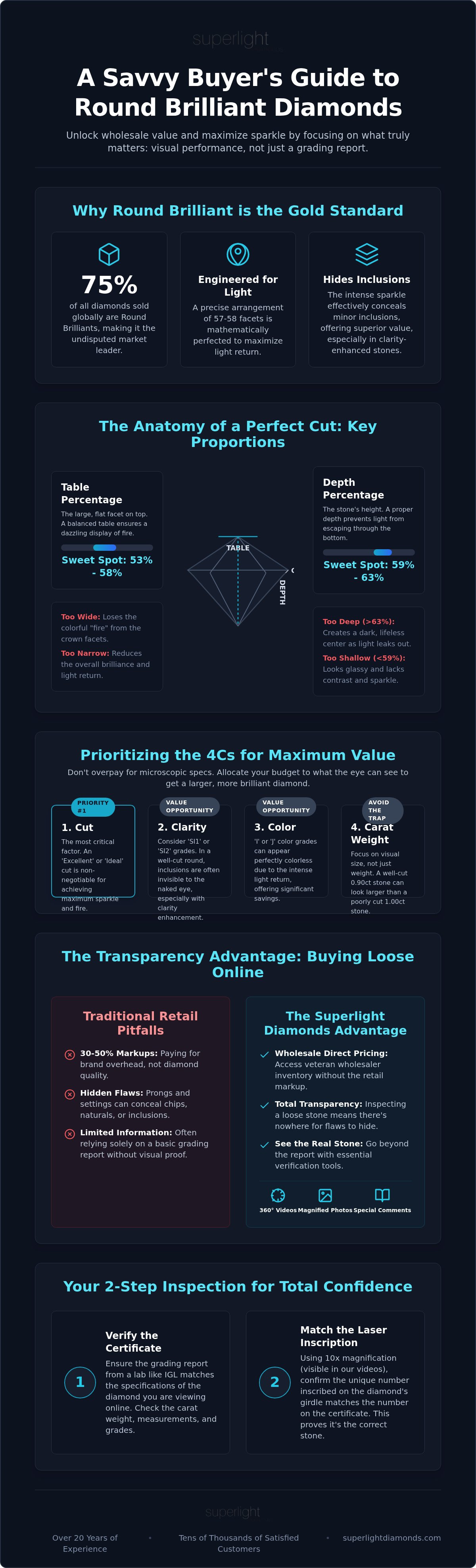
The round brilliant cut is the undisputed leader in the gemstone market. Statistics show that 75% of all diamonds sold globally are round brilliants. This dominance isn't just about tradition; it's about performance. By using a precise arrangement of 57 or 58 facets, this cut is engineered to return the maximum amount of light to the eye. When you shop for round brilliant loose diamonds, you're looking at a stone that has been mathematically perfected for over a century to outshine every other shape. This cut offers unparalleled versatility, giving you the freedom to choose your stone first and then select a custom setting that matches your personal style.
The Physics of Fire and Brilliance
Understanding the appeal of this cut requires a look at how it handles light. Brilliance refers to the white light reflected from the diamond's interior, while fire describes the vivid, rainbow-like flashes of color. The geometry of a round cut facilitates total internal reflection, which means light enters through the top, bounces off the pavilion facets, and exits back through the crown. This specific Anatomy of a Diamond Cut is why round stones hide inclusions more effectively than step-cuts like emerald or asscher. For buyers focusing on natural, clarity-enhanced stones, this means you can achieve a stunning visual impact and a larger stone without paying for microscopic clarity grades that the naked eye cannot detect.
Buying Loose vs. Pre-Set: The Transparency Gap
Choosing a loose stone over a pre-set ring closes the transparency gap that often exists in retail showrooms. Jewelers may use prongs to hide chips on the girdle or "naturals" that weren't polished away. When a diamond is loose, there's nowhere for flaws to hide. You can verify the exact carat weight and measurements with total accuracy. Investing in round brilliant loose diamonds also ensures price transparency. You aren't guessing how much of the total price is the diamond and how much is the retail markup on the mounting. It's about seeing the stone for exactly what it is before it's locked in a setting. Superlight Diamonds has spent over 20 years demystifying this process, providing 360-degree videos and highly magnified photos so you can inspect every facet from the comfort of your home. This level of disclosure is what has allowed us to serve over 21,000 satisfied clients since 2001.
The Technical Anatomy of a Perfect Round Cut
While the previous section established why this shape is the market leader, achieving the highest level of sparkle requires a deep dive into technical proportions. For round brilliant loose diamonds, the cut grade is the most critical factor. An "Excellent" or "Ideal" cut ensures that light is directed properly through the crown rather than leaking out the sides. If the cut is poor, even the highest clarity diamond will look dull and lifeless. To understand how these grades are determined, many experts reference the American Gem Society (AGS) Diamond Grading System, which uses a scientific approach to measure light performance on a 0 to 10 scale.
Two critical measurements define a stone's personality: table percentage and depth percentage. The table is the large flat facet on top. You should look for a "sweet spot" between 53% and 58%. If the table is too wide, you lose the crown area that creates fire. Depth percentage is equally vital. Stones that are too deep, typically over 63%, often look dark because light leaks out the bottom. Conversely, stones that are too shallow, under 59%, look "glassy" and lack contrast. Finding a balance between these numbers ensures that your stone has a crisp, high-end sparkle that is visible even from a distance.
Prioritizing the 4Cs for Maximum Value
Smart buyers know that you don't need "Flawless" clarity to have a beautiful stone. Because of how effectively this cut reflects light, you can often drop to an "SI1" or "SI2" clarity grade without noticing inclusions with the naked eye. This is especially true for natural, clarity-enhanced options. These stones are optimized for beauty, allowing you to secure a larger diamond at a much lower price point. Similarly, "I" or "J" color grades often look perfectly colorless in a round brilliant cut because the intense light return masks faint yellow tints. Avoid the "carat trap" where you pay for weight instead of size. A poorly cut 1.00ct stone can actually look smaller than a well-cut 0.90ct stone because too much weight is hidden in a thick girdle or deep pavilion.
Understanding Girdle and Culet Specifications
The girdle is the edge where the crown meets the pavilion. A "Medium to Slightly Thick" girdle is the safest choice for long-term durability. It provides enough metal contact for a secure setting without adding unnecessary weight. The culet is the tiny facet at the very bottom of the diamond. The culet’s role is to prevent light leakage at the base, and you should aim for a "None" or "Pointed" specification. A large culet can look like a dark hole in the center of your diamond when viewed from the top. You can explore our current inventory of round brilliant loose diamonds to see how these technical specs translate into real-world beauty by visiting Superlight Diamonds today.
Pricing Strategies: Avoiding the Retail Diamond Markup
Traditional brick-and-mortar stores face massive overhead. Rent, commissioned staff, and expensive insurance policies add 30% to 50% to the price of a diamond. When you shop for round brilliant loose diamonds through these channels, you're paying for the showroom experience, not just the stone. High-volume online specialists eliminate these middleman costs. This allows you to secure a higher-quality natural diamond for the same budget. Transparency is the key to this value. By separating the stone from the setting, you see exactly where your money is going.
The Power of No-Reserve Diamond Auctions
Auctions represent the most transparent way to find the true market value of a stone. Unlike fixed retail prices, no-reserve auctions let the market decide what a diamond is worth in real-time. This model works. Superlight Diamonds has pioneered this approach on eBay, maintaining a top-rated seller status by offering thousands of stones with total transparency. When bidding, always check the seller's long-term history and return policies. This strategy allows savvy buyers to find market-driven pricing that isn't inflated by arbitrary retail markups. It's the ultimate tool for those who prioritize value over a luxury showroom name.
Clarity Enhanced Diamonds: High Quality at a Lower Entry Point
If you want to maximize the size and sparkle of your round brilliant loose diamonds, clarity enhancement is a strategic choice. This process involves making microscopic natural feathers invisible to the naked eye. It doesn't change the diamond's natural origin. It simply improves its visual appeal. On average, this allows for savings of approximately 30% compared to a non-enhanced natural stone of the same visual grade. It's a practical way for everyday consumers to afford a larger, more impressive stone without sacrificing the eye-clean look. These stones are durable for everyday wear, requiring only standard precautions like avoiding high-heat torches during jewelry repairs.
Certification remains the backbone of a safe purchase. While GIA is a common benchmark, we often utilize IGL (International Gemological Laboratories) for objective grading. These reports are essential for price benchmarking. However, they shouldn't be the only tool you use. Our detailed "Special Comments" and 360-degree videos provide the context a certificate can't. They show you exactly how the diamond performs in motion. This combination of lab grading and visual transparency has helped us serve over 21,000 clients since 2001. You get an honest look at the stone's character before you commit to the purchase.
A Step-by-Step Inspection Guide for Loose Diamonds
Once you've narrowed your search to a few round brilliant loose diamonds, you need a methodical way to verify their quality. The first step is confirming the stone's identity. Match the certificate number from your report, whether from IGL or another lab, to the microscopic laser inscription on the diamond's girdle. This ensures the physical stone matches the technical data you've analyzed. If you're buying online, high-magnification photography should make this inscription clearly visible. It's a simple security measure that builds immediate trust in the transaction.
Next, use a 10x magnification loupe to locate the inclusions noted on the grading plot. This helps you understand the stone's internal character and confirms that the plot is accurate. You should also analyze the "Hearts and Arrows" pattern, which reveals the precision of the optical symmetry. While a perfect pattern isn't always required for a beautiful stone, it indicates a high level of craftsmanship. Finally, check for fluorescence. This trait is often misunderstood. In lower color grades like "J" or "K," a touch of blue fluorescence can actually make the stone appear whiter. However, you should avoid "Strong" fluorescence in high-color stones, as it can sometimes cause a hazy or "oily" appearance in natural sunlight.
Reading the Diamond Grading Report Like a Pro
The "Comments" section of a report often holds more information than the clarity grade itself. For instance, a note stating "Clarity grade is based on clouds not shown" suggests that the stone's appearance is defined by microscopic clusters rather than a single large crystal. For most buyers, the goal is an "eye-clean" stone. This means that even if a stone has an SI1 or SI2 clarity grade, the inclusions aren't visible to the naked eye at a standard viewing distance. Always check the date on the report. A certificate that's several years old might not reflect the stone's current condition, especially if it's been handled or stored improperly. Transparency is vital; that's why we provide detailed "Special Comments" on every listing to explain these nuances clearly.
Assessing Light Performance Online
Since you can't hold the stone before purchasing, you must rely on advanced imaging. 360-degree videos are the best way to spot "dead spots," which are areas where light doesn't reflect properly. As the stone rotates, every facet should flash; if a section remains dark, the cut may be asymmetrical. Look for tools like ASET or IdealScope images if they're available, as these highlight exactly where light leakage is occurring. Most importantly, never buy from a vendor that doesn't offer a "no questions asked" return window. A 30-day return policy allows you to inspect the stone in your own home and confirm it meets your expectations. Inspect our latest round brilliant loose diamonds with highly magnified 360-degree videos today.
Choosing Your Stone: The Superlight Diamonds Advantage
Selecting the right diamond requires a partner that prioritizes transparency over high-pressure sales tactics. Since 2001, Superlight Diamonds has bridged the gap between wholesale markets and everyday consumers. We have served over 21,000 satisfied clients by providing a straightforward, educational approach to buying round brilliant loose diamonds. Our longevity in the industry isn't just a number. It represents two decades of refining a high-volume model that rewards savvy buyers who value beauty and size over microscopic paper grades. We don't just list stones; we provide the technical context you need to make an informed decision.
Every stone in our inventory undergoes a rigorous vetting process by veteran gemologists. Our experts look specifically for stones that maximize brilliance and fire, ensuring that even clarity-enhanced options perform at a high visual level. This curation process is designed to help you find the best value within your specific budget. We focus on natural, earth-mined diamonds that offer an impressive presence on the hand. By specializing in clarity enhancement, we provide a path to owning a larger, eye-catching stone that would otherwise be out of reach at traditional retail prices.
A Legacy of Trust and Transparency
Our business model is built on the principle of total disclosure. As a top-rated seller on eBay, we have pioneered the use of high-definition media to demystify the online purchase process. While many retailers use stock photos or generic videos, we provide highly magnified 360-degree videos of the actual stone you are buying. Our detailed "Special Comments" are a core pillar of our brand. These notes disclose characteristics that aren't always obvious from an IGL grading report. This fact-based, business-like approach ensures that there are no surprises when you open the box. Our high-volume model allows us to maintain competitive pricing that brick-and-mortar stores simply cannot match due to their overhead.
Your Next Steps to Owning a Round Brilliant
Ready to find your perfect stone? You can begin by browsing our current inventory of certified round brilliant loose diamonds on our website. Each listing includes the technical specifications and visual tools we've discussed throughout this guide. If you prefer a market-driven approach, you can participate in our upcoming no-reserve auctions on eBay. These auctions are the ultimate way to secure a diamond at true market value. If you have questions about a specific stone's "Special Comments" or technical specs, our experts are available for personalized consultations to help you buy with total confidence. Start your search today and discover how beautiful an honest price can look.
Secure Your Perfect Stone with Total Confidence
Owning a stunning natural diamond doesn't require a retail-inflated budget. By mastering the technical nuances of the cut and prioritizing visual performance over microscopic grading paper, you can secure a stone that truly stands out. Remember to focus on the "sweet spot" for table and depth percentages while using high-definition video to verify transparency. This approach ensures you get the maximum sparkle and size for your investment without paying for a brand name's overhead.
With 20 years of expertise and over 21,000 satisfied clients, we're committed to helping you find the right value. Our top-rated eBay seller status is a testament to our transparent, business-like approach. Whether you're looking for clarity-enhanced options or traditional natural stones, our detailed listings give you the full story behind every facet. Don't settle for retail markups when you can buy directly from a veteran wholesaler. Browse our collection of round brilliant loose diamonds today and find the beauty you deserve at an honest price. Your ideal diamond is waiting.
Frequently Asked Questions
What is the best cut for a round brilliant loose diamond?
The best cut grade for a round stone is "Excellent" or "Ideal" because these proportions maximize light return. You should look for a table percentage between 53% and 58% and a depth percentage between 59% and 62.5%. These specific ranges ensure the diamond reflects the most sparkle without looking dark or glassy. A precise cut is the most important factor in determining the stone's overall beauty and fire.
Are round brilliant diamonds more expensive than other shapes?
Round brilliant diamonds generally carry a higher price per carat than fancy shapes like pear or cushion. This premium exists because the cutting process for a round stone requires removing more of the original rough diamond crystal. High global demand also keeps prices elevated. However, you can secure round brilliant loose diamonds at a better value by choosing clarity-enhanced natural stones or buying through high-volume wholesalers like Superlight Diamonds.
How can I verify if a loose diamond is real when buying online?
You can verify a stone's authenticity by matching the laser inscription on its girdle to the number on its grading report. Reliable online sellers provide highly magnified photos and 360-degree videos so you can see this inscription clearly. Once the stone arrives, you can also have it tested by an independent local gemologist. Always ensure the vendor offers a clear return policy to protect your purchase during the inspection period.
Is a clarity-enhanced round brilliant diamond a good investment?
Clarity-enhanced stones are an excellent investment in beauty and size for value-conscious buyers. While they may not have the same resale profile as non-enhanced stones, they allow you to own a much larger natural diamond for a significantly lower price. This makes them ideal for engagement rings or jewelry meant for daily wear. You get an eye-clean, natural stone that offers 100% of the sparkle at a fraction of the cost.
What is the difference between a natural and a lab-grown round brilliant?
Natural diamonds are earth-mined gems formed over billions of years, while lab-grown diamonds are factory-produced in a matter of weeks. By mid-2026, the price gap between the two has widened to approximately 75% or 80%. We focus exclusively on natural, earth-mined round brilliant loose diamonds because our clients value the lasting status of a genuine stone. Natural diamonds maintain a market presence that synthetic alternatives simply cannot replicate.
How do I choose the right carat weight for a round brilliant stone?
You should choose carat weight based on the stone's physical dimensions rather than just its weight. A poorly cut 1.00ct diamond can actually look smaller than a well-cut 0.90ct stone if the weight is hidden in a deep pavilion. Look for the "millimeter spread" on the grading report to see how large the diamond will actually appear when set. Focus on maximizing the visual size within your specific budget.
What should I look for in a diamond grading report for a round cut?
Start by checking the cut, symmetry, and polish grades, as these dictate the stone's sparkle. Then, review the "Comments" section for details that the clarity grade doesn't fully explain. We typically use IGL reports to provide an objective baseline for our inventory. It's vital to pair the report with 360-degree videos and our "Special Comments" to understand the diamond's true character before you make a final decision.
Can I mount a loose diamond I bought online at a local jeweler?
Most local jewelers are happy to mount a loose diamond that you purchased elsewhere. This is a very common practice that gives you total control over the design of your ring or pendant. Before you visit the jeweler, it's a good idea to ask about their setting fees for "outside stones." This strategy often saves you money because you aren't paying the high retail markups typically found on pre-set jewelry in showrooms.