Loading... Please wait...
 USD



Recent Posts
Fracture-Filled Diamond vs. Laser-Drilled: Key Differences
Posted on
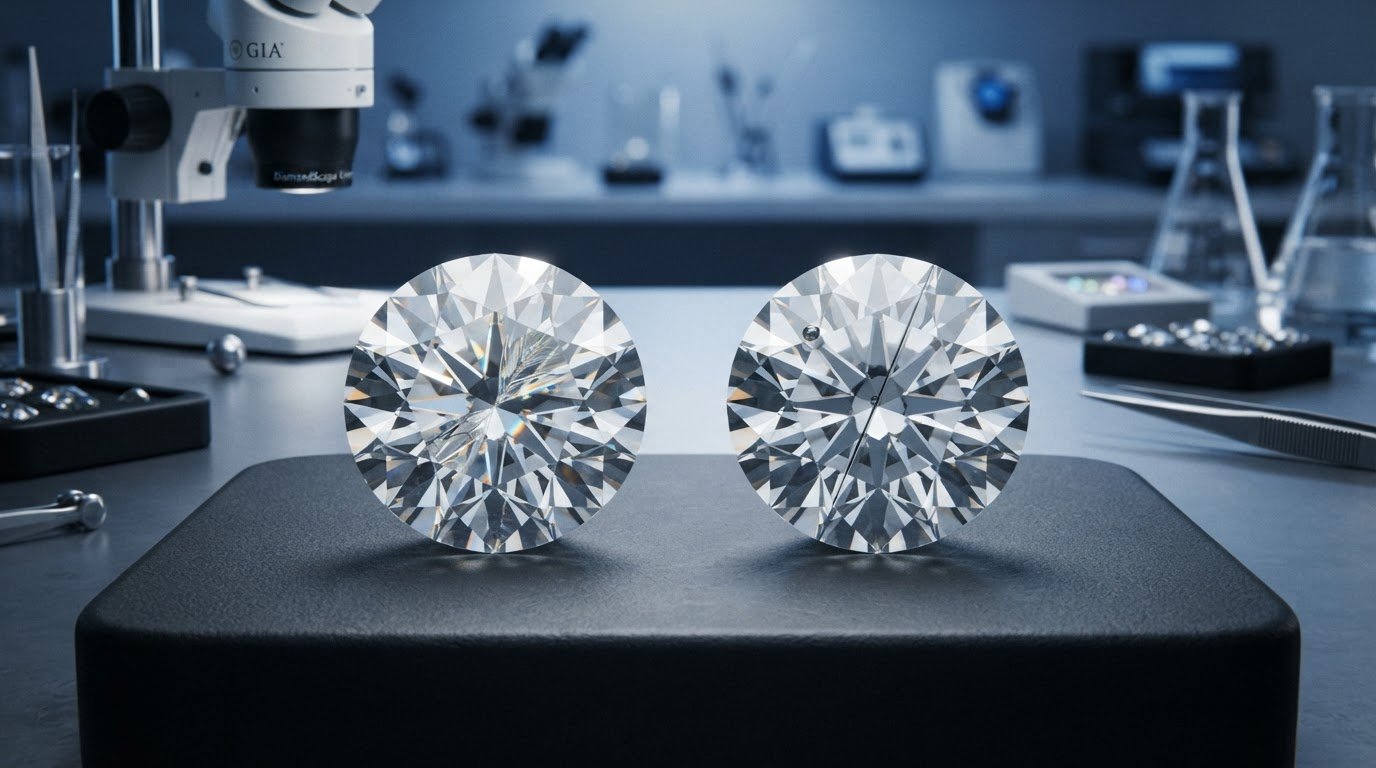
A diamond’s appearance doesn’t tell you everything about its clarity treatment. In a fracture filled diamond vs laser drilled comparison, both treatments address visible inclusions, but they work differently and come with different care considerations. If you’re comparing diamonds, it helps to understand what each treatment means for the particular stone, especially since a grading report may not answer every practical question.
We’ll explain how fracture filling and laser drilling differ, what to know about their permanence and care, and which details to review before choosing a diamond. At Superlight Diamonds, we specialize in natural, earth-mined diamonds, and most of our selection is clarity enhanced. This gives buyers another way to find a beautiful natural diamond at an honest price. For a more complete picture, review the exact diamond’s report alongside its highly magnified photographs, 360° video, and listing “Special Comments.”
Key Takeaways
- Fracture filling makes a feather less noticeable, while laser drilling creates a narrow channel to treat an inclusion.
- In the fracture filled diamond vs laser drilled comparison, treatment type affects care considerations, so review the specific stone’s disclosed treatment details.
- A clarity treatment isn’t automatically a reason to reject a natural diamond. Consider its disclosure, report, visible characteristics, and how you plan to use it.
- Assess the exact diamond using its report, magnified photographs, 360° video, and listing comments together before deciding whether it suits your priorities.
Fracture-filled diamond vs. laser-drilled: what each treatment does
Clarity enhancement is a treatment that improves a diamond’s apparent clarity without changing its natural origin. It can make an inclusion less noticeable, but the method matters because each treatment affects a different feature inside the stone. Knowing the difference makes the fracture filled diamond vs laser drilled comparison easier to understand.
How the two clarity treatments differ inside a diamond
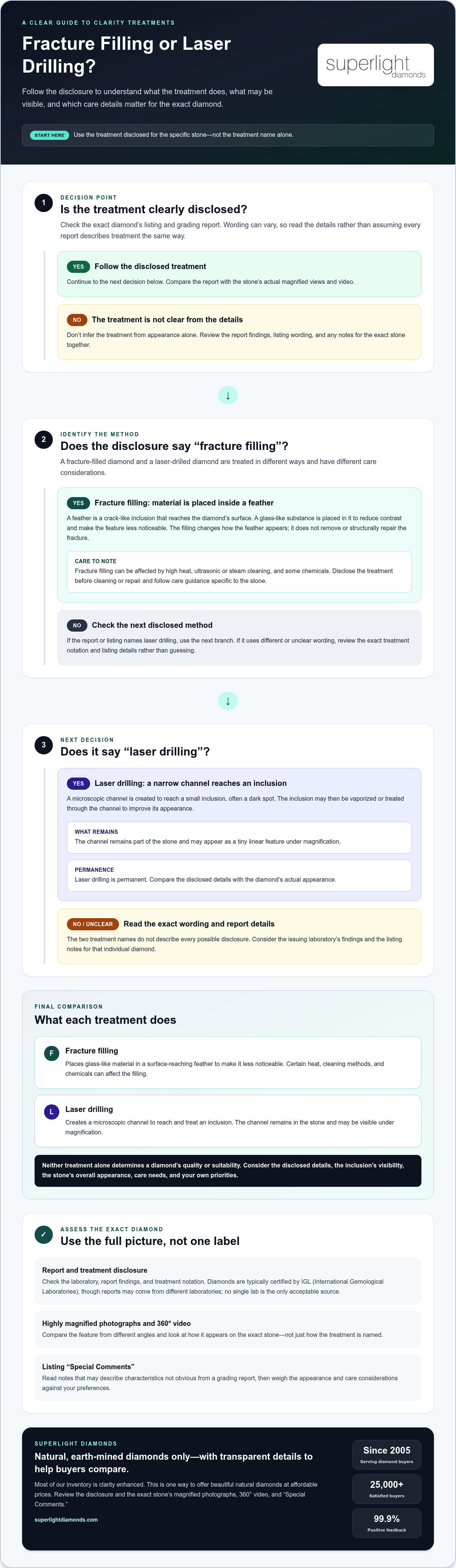
Laser drilling creates a microscopic channel through the diamond to reach a small inclusion, often a dark spot. The inclusion may then be vaporized or treated through the channel to improve its appearance. The channel remains part of the stone and may appear as a tiny linear feature under magnification.
Fracture filling addresses a different characteristic. A feather is a crack-like inclusion that reaches the diamond’s surface. A glass-like substance is placed in the feather to reduce the contrast between it and the surrounding diamond, making the feature less noticeable. The filling changes how the feather appears, but it doesn’t remove or structurally repair the fracture.
In short, laser drilling creates a channel to treat an inclusion, while fracture filling places material inside a surface-reaching feather to make it less visible.
Neither treatment alone determines a diamond’s quality or suitability. Consider the location and visibility of the inclusion, the stone’s overall appearance, and how clearly the treatment is disclosed. When comparing diamonds, look at the actual magnified views and video rather than relying on the treatment name alone.
At Superlight Diamonds, we specialize in natural, earth-mined diamonds, and most of our inventory is clarity enhanced. Clarity enhancement can make beautiful natural diamonds more accessible at a price that suits your budget. The important thing is to understand the disclosure and assess the individual stone.
Does a clarity treatment make a diamond a poor choice? How to compare
No. A disclosed clarity treatment isn’t automatically a reason to reject a natural diamond. Weigh it alongside the stone’s appearance, documentation, care needs, and fit for your priorities. For background on the inclusions these treatments address, see AGS on Diamond Inclusions.
What to review before choosing a treated diamond
Compare the details for the exact stone, not just the treatment labels:
- Disclosure: Look for a clear description of the treatment in the listing and any grading report. Wording can vary, so read the details rather than assuming every report describes treatments in the same way.
- Report details: Diamonds are typically certified by IGL (International Gemological Laboratories), though reports may come from different laboratories. Review the issuing laboratory, the report’s findings, and any treatment notation. No single lab should be treated as the only acceptable source.
- Visible characteristics: Compare the report with the highly magnified photographs, 360° video, and listing comments for that exact stone. Check whether the inclusion or treatment feature is visible from the angles that matter to you.
- Intended use and care: Consider how you plan to wear and maintain the diamond. Fracture filling can be affected by high heat, ultrasonic or steam cleaning, and some chemicals. Before cleaning or repair, disclose that the diamond is fracture filled and follow care guidance specific to the stone.
In the fracture filled diamond vs laser drilled comparison, care is one practical difference to consider. Laser drilling is permanent, while fracture filling may be vulnerable to certain procedures. A treatment label alone can’t tell you whether a stone fits your budget or preferences. Review the disclosures and exact-stone details together, then compare the diamond’s appearance with the qualities you value most. Superlight Diamonds shares clarity-enhanced natural diamond listings with details to help you compare.
How Superlight Diamonds makes clarity-enhanced natural diamonds easier to assess
Superlight Diamonds specializes in natural, earth-mined diamonds, and most of our inventory is clarity enhanced. Our large online selection and competitive pricing give buyers more ways to find a natural diamond that fits their priorities and budget. Since 2005, we’ve served over twenty-five thousand satisfied buyers and earned a 99.9% positive feedback rating.
Use the exact diamond's listing to make an informed decision
Review the specific stone’s grading report alongside its highly magnified photographs and 360° video. The listing’s “Special Comments” can describe characteristics that may not be obvious from a report, helping you assess what you see instead of relying on a treatment label alone.
For example, compare any described feature with the diamond’s appearance from different angles, then decide whether it suits your preferences. Looking closely at the exact stone makes the fracture-filled and laser-drilled distinction more useful when comparing individual listings.
For more buyer guidance, explore Clarity Enhanced Diamonds: The Savvy Buyer’s Guide to Natural Brilliance, then use the listing details to make a considered choice.
Choose the diamond that fits your priorities
Start by deciding which qualities matter most in a diamond you’ll enjoy wearing. You might prioritize a particular look, a comfortable budget, or a balance between size and clarity. Treatment is one part of that decision, not a substitute for assessing the individual stone. Use what you’ve learned about fracture filled diamond vs laser drilled to focus your comparison on the diamond’s disclosed details and appearance.
At Superlight Diamonds, transparent listings help you compare natural loose diamonds with care. Consider how each stone aligns with your preferences, the details in its report, and the views shown in its photographs and video. Explore natural loose diamonds with detailed listing information and choose the one that feels beautiful to you and makes sense for your budget.
Frequently Asked Questions
Are fracture-filled diamonds still natural diamonds?
Yes. Fracture filling is a clarity treatment, and it doesn’t change a diamond’s natural origin. Natural origin and treatment history are separate details, so review both when assessing a specific stone. The listing disclosure and report can help clarify the treatment described for that diamond, rather than leaving you to infer its history from appearance alone.
Can a diamond be both laser-drilled and fracture-filled?
Yes, a diamond may have more than one clarity treatment. In a fracture filled diamond vs laser drilled comparison, don’t assume that a stone has both treatments based on a visible feature or general description. Review its report and listing together, paying attention to how each treatment is disclosed.
Is fracture filling permanent?
No. Fracture filling may be damaged or removed during certain cleaning or repair procedures. Keep the diamond’s treatment information with its jewelry records and share it before any maintenance. Follow care guidance specific to the stone, rather than assuming a cleaning method suitable for one diamond is appropriate for every treated stone.